Build Your Unforgettable Career Portfolio: A Personal Guide
A career portfolio is your professional storybook—a hand-picked collection of my best work that shows employers what I’m made of, instead of just telling them. I think of it as the evidence that proves the skills listed on a resume are the real deal.
Why a Career Portfolio Is Your Ultimate Power Move
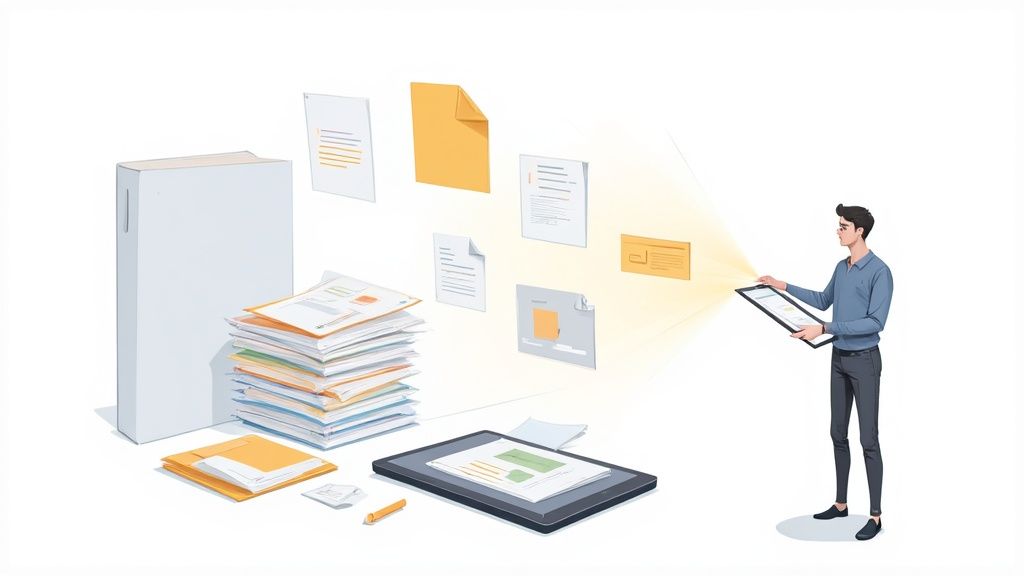
For years, my professional life was a total mess of scattered files. I had a brilliant design stashed in one folder, a winning marketing plan in another, and glowing client testimonials buried deep in my email archives. I knew I was doing good work, but I had no way to pull it all together into a cohesive story.
My resume listed skills like "Project Management" and "Content Strategy," but those words just felt empty without any real proof to back them up.
It wasn't until I was interviewing for my dream job that it hit me. The hiring manager asked for examples, and I found myself fumbling through disorganized folders, feeling completely unprofessional. That weekend, I sat down and built my first real career portfolio. It was a game-changer.
Putting my projects into a clear narrative didn't just impress employers; it actually gave me a huge boost of confidence in my own skills. I wasn't just a list of bullet points on a page anymore. I was a professional with a track record of success I could prove.
The Shift from Claiming to Proving
In a job market this competitive, a traditional resume just doesn't cut it anymore. With recruiters spending an average of just 7.4 seconds scanning a resume, you have to find a way to make an immediate impact. A portfolio delivers that instant, compelling evidence that shows them your true value.
It completely changes the conversation from what you claim you can do to what you have actually done. This is what separates the top candidates from everyone else.
A well-crafted career portfolio helps you:
- Provide Tangible Evidence: Don't just list "data analysis" as a skill. Show them the report you created that led to a 15% jump in efficiency.
- Control Your Narrative: This is your chance to tell your professional story on your own terms, highlighting the wins you’re most proud of.
- Stand Out from the Crowd: While hundreds of applicants submit nearly identical resumes, a portfolio is a unique and personal showcase of your talent.
Beyond a Simple Resume
To put it simply, think of your resume as the table of contents and your career portfolio as the book itself. The resume gives a quick overview, but the portfolio brings your story to life with rich detail and vivid examples.
For a quick breakdown of how these two documents stack up, here’s a side-by-side look.
Resume vs Career Portfolio At a Glance
| Feature | Traditional Resume | Career Portfolio |
|---|---|---|
| Purpose | To summarize your work history and skills | To showcase your abilities and prove your impact |
| Format | Text-based, typically one or two pages | Dynamic, often digital, with mixed media |
| Content | Bullet points, dates, job titles | Case studies, visuals, project examples, testimonials |
| Nature | A static, historical document | A living, evolving collection of your best work |
| Goal | To get you an interview | To demonstrate your value and secure the offer |
This table really highlights the core difference: a resume tells, while a portfolio shows.
A resume is static, often updated only when you're actively job hunting. A career portfolio, on the other hand, is a living document. It evolves as you learn new skills, complete new projects, and grow in your career.
This dynamic nature is exactly what makes it so powerful. For creatives, it’s a visual feast of their best work. For developers, it’s a repository of functional projects. Even for roles that aren't inherently visual, you can include case studies, strategic plans, or client testimonials. The goal is always the same: demonstrate your impact. For some great ideas on how to present your work, check out these awesome design portfolio examples to see how other pros tell their stories.
Ultimately, building a career portfolio is an investment in yourself. It's the most effective way to document your journey, showcase your expertise, and prove your worth in a market that values skills above all else.
Navigating the New Skill-Based Economy

The world of work has quietly but completely changed. Gone are the days when a fancy degree or years spent at one company were all you needed. Today, we're all playing in a skill-based economy, where what you can actually do is worth far more than where you've been.
This isn't just a passing trend. It’s a fundamental rewiring of how companies find and value people. They're quickly realizing that a diploma doesn't always guarantee real-world problem-solving skills. What they want is tangible proof.
This shift means a career portfolio is no longer just a nice-to-have for designers and artists. It’s become your most important asset in this new job market—the one tool that makes your value undeniable to employers who care about proven ability.
Your Skills Are Your New Currency
Think of the job market like an exchange. Your resume used to be your passport, getting you in the door based on your history. Now, your portfolio is your currency, and each project is a high-value coin that shows exactly what you bring to the table.
This is especially true as companies are overhauling how they decide what to pay people. According to a massive PwC Global Compensation Study, 72% of Fortune 500 companies now use skill matrices to set pay scales. They're ditching old models and rewarding people for specific, measurable expertise.
It’s no surprise, then, that in-demand skills in fields like AI and cybersecurity now command average salaries between $160,000 and $185,000 in major cities. The message is crystal clear: companies will pay a premium for skills they can see and verify. A resume claims you have those abilities; a portfolio proves it.
Showcasing Both Hard and Soft Skills
A common mistake I see people make is thinking a portfolio is only for technical, or "hard," skills. While it's perfect for showing off your coding or data analysis chops, its real power is in making your soft skills just as visible.
A great portfolio doesn't just show what you created; it tells the story of how you created it. It provides context that reveals your collaboration, problem-solving, and leadership abilities in action.
So, how does a gallery of projects prove you're a leader or a great communicator? It’s all about how you frame your work.
- For Leadership: Don't just show the final product. Write a case study on a project you led. Talk about how you delegated tasks, motivated the team, and navigated roadblocks to get it done on time and under budget.
- For Problem-Solving: Walk them through a tough challenge you faced. What was your thought process? What solutions did you consider, and why did you pick the one that ultimately worked? Show your thinking.
- For Communication: Include a few testimonials from clients or colleagues. Look for quotes that specifically mention how you explained complex ideas clearly or managed stakeholder expectations like a pro.
By presenting your work this way, you make intangible skills tangible. You’re not just listing "team player" as a buzzword; you're showing a real-world example of your teamwork leading to a measurable victory. To see how top professionals weave these stories together, check out this career portfolio example.
This approach turns your portfolio from a simple collection of work into a powerful story about who you are as a professional—and it's exactly what the new skill-based economy demands.
Assembling Your Winning Career Portfolio
Alright, let’s move from theory to action. This is where your career portfolio really starts to come alive. Think of yourself as the curator of your own professional exhibit. Every single piece you choose has to earn its spot, working together to tell a powerful, cohesive story. This isn't about just dumping every project you've ever touched into a folder—it's about strategic, intentional selection.
The whole point is to build a narrative that doesn't just list your skills but actually proves them. Let’s walk through the essential building blocks you'll need to turn abstract accomplishments into tangible proof that will grab the attention of any hiring manager or potential client.
Start with a Compelling Professional Summary
First impressions matter. Your professional summary, or bio, is the first thing people read, and it sets the tone for everything else. Ditch the dry, third-person descriptions that sound like they were written by a robot. Your goal is to write a short, engaging intro that spells out your core expertise, what makes you unique, and what gets you fired up professionally.
I always tell people to think of it like the opening scene of a movie—it has to hook the audience and make them want to see what happens next. A great summary nails three key questions:
- Who are you? (e.g., "A data-driven marketing strategist…")
- What do you do best? (e.g., "…with a knack for turning complex data into clear, actionable growth strategies.")
- What are you passionate about? (e.g., "I'm passionate about helping tech startups find their voice and build loyal communities.")
This approach immediately gives your work context. It tells people who you are and why you do what you do. To make sure your digital presence is as sharp as your physical one, investing in comprehensive profile optimization is a smart move to ensure you're putting your best foot forward online.
Curate Your Most Impactful Work Samples
This section is the heart and soul of your portfolio. Notice the key word here: curate. Quality beats quantity every single time. A portfolio with five outstanding, well-documented projects will always be more powerful than one with twenty mediocre examples just thrown in for filler.
You want to pick pieces that show both the breadth and depth of your skills. But don't just show the final product—give it some context. Tell the story behind it.
Explain the problem you were trying to solve. Get specific about your role and the steps you took. And, most importantly, show the results. Quantify your impact.
Did you help increase sales by 20%? Or maybe you reduced customer support tickets by 30%? Hard numbers provide concrete evidence of your value and make your contributions impossible to ignore.
To give you a better idea of what this looks like across different fields, here’s a quick breakdown of what you might include.
Portfolio Content Checklist by Profession
| Profession | Key Portfolio Components | Example Artifact |
|---|---|---|
| Marketing | Campaign case studies, content samples (blogs, videos), social media analytics reports, SEO audit results. | A case study detailing a PPC campaign that shows ad spend, conversion rates, and ROI. |
| Graphic Design | Branding packages, website mockups, print materials (brochures, posters), illustration work, UI/UX wireframes. | A PDF showcasing a complete brand identity project, from initial logo sketches to the final style guide. |
| Software Dev | Code samples on GitHub, links to live applications, project case studies explaining the tech stack and problem-solving. | A link to a deployed web app with a brief write-up on the technical challenges and how you solved them. |
This table just scratches the surface, but it illustrates how different professions can translate their work into compelling, tangible evidence. The goal is always the same: show, don't just tell.
Gather Testimonials That Build Credibility
Let's be honest: what other people say about you is often more convincing than what you say about yourself. Testimonials and recommendations are your social proof. They build trust and validate your skills from an objective, third-party perspective.
Reach out to former managers, happy clients, or even colleagues you collaborated with closely. Don't just ask for a generic recommendation; guide them. Ask specific questions like, "Could you talk about my project management skills on the X project?" or "What was the most significant impact of that marketing campaign we ran together?" This helps you get quotes that are targeted and genuinely impactful.
Create a Detailed Skills Inventory
Finally, you need a dedicated section for your skills. But please, don't just create a laundry list of buzzwords. Make it meaningful by grouping your skills into logical categories like "Technical Skills," "Software Proficiencies," or "Soft Skills."
For any technical abilities, think about adding proficiency levels (like Expert, Advanced, or Intermediate) to give a clearer picture. And for soft skills, link them back to your work. For instance, next to a skill like "Leadership," you could link directly to a case study where you successfully led a team. This small step transforms an abstract claim into a demonstrated, proven ability. The visual layout of all these elements is just as important as the content itself; you can find some great ideas on effective portfolio website design to make sure your skills and projects really pop.
When you thoughtfully assemble these four core components, you’re not just making a collection of files. You're building a rock-solid, persuasive argument for why you’re the right person for the job.
How Employers Use Portfolios to Find Top Talent
Let's pull back the curtain for a moment. When a hiring manager gets your application, what are they really looking for?
Having sat on that side of the desk, I can tell you it’s more than just keywords and job titles. We’re searching for a story—for tangible proof that a candidate can not only do the job but will also thrive, adapt, and drive real results. This is where a career portfolio becomes a hiring manager’s secret weapon for finding the truly great candidates among the good ones.
In a world where Applicant Tracking Systems (ATS) often act as the first gatekeeper, a portfolio is how you make a genuine human connection. Your resume might get you past the bots, but it's the portfolio that convinces the person on the other side that you’re the one they need to talk to.
It’s the difference between a flat, black-and-white summary and a full-color demonstration of your professional journey.
Beyond the Resume: The Search for Evidence
Employers are drowning in resumes that all sound the same. Everyone is a "detail-oriented team player" with "strong communication skills." A career portfolio cuts right through that noise by offering something much more powerful: evidence.
It’s the tangible proof that validates every claim on your resume.
When a recruiter reviews a portfolio, they're not just looking at your work; they're assessing your thought process, your problem-solving skills, and your ability to deliver measurable outcomes.
It’s one thing to say you managed a project. It's something else entirely to present a case study showing the project timeline, your specific contributions, and the successful outcome. This shift from simply claiming skills to actually proving them is what makes a candidate unforgettable.
What Recruiters See: A Hierarchy of Value
When scanning a portfolio, hiring managers have to triage information fast to see if you’re a good fit. They’re looking for specific things in a specific order. The infographic below shows the core components they look for to build a quick, yet comprehensive, picture of your capabilities.
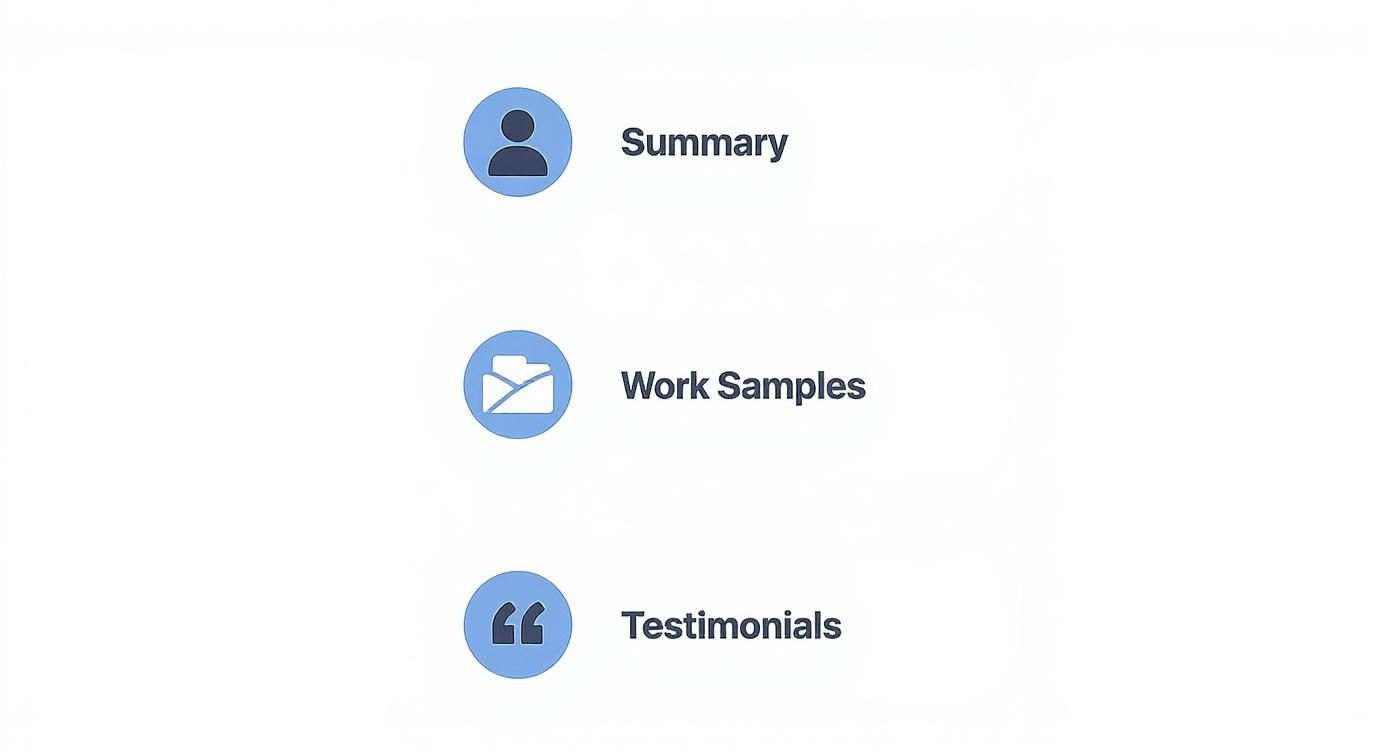
This hierarchy shows how recruiters can instantly grasp your professional identity, see concrete proof of your skills, and then find social validation for your work. A portfolio that lays these elements out clearly makes a hiring manager's job easier—and makes you a much stronger contender.
Demonstrating Adaptability and Future Potential
In today’s fast-moving job market, employers are hiring for the future, not just the present. We want people who are curious, adaptable, and committed to learning. A portfolio is the perfect place to showcase these forward-thinking qualities.
Global talent trends show just how critical this is. A recent report from Mercer reveals that about half of all employers are actively reorienting their strategies to incorporate AI, and a staggering two-thirds are specifically recruiting for talent with AI-related skills. On top of that, 58% of organizations are focused on enhancing what they offer employees, meaning they’re looking for candidates invested in their own growth. You can dive deeper into these global talent management trends on Mercer.com.
A portfolio that includes projects using new tech, certifications for recently acquired skills, or even a blog where you analyze industry trends instantly signals that you are an agile, proactive professional. It tells an employer that you won't just keep up; you'll help lead the way. This is a powerful signal, especially for getting past automated screening. For more on that, you might find our guide on how to beat ATS systems helpful.
All this makes your career portfolio an indispensable asset for landing a top-tier role.
Future-Proofing Your Career with a Living Portfolio

Your career isn’t some static, finished product, so why would you treat your portfolio that way? Too often, I see people pour their heart into building a portfolio, land a job, and then let it collect digital dust for years. That’s a massive missed opportunity.
The most powerful career portfolio is a living, breathing document—one that evolves right alongside your professional journey.
Think of it less as a scrapbook of past glories and more as your career’s command center. It shouldn't just show where you've been; it should be actively mapping out where you're headed. This dynamic approach is what separates a simple archive of old projects from a strategic tool that genuinely future-proofs your career.
Staying Ahead of Industry Shifts
The job market is in a constant state of flux, and the pace of change is only getting faster. To stay relevant, you have to treat your career like a lifelong learning project. Your portfolio is the perfect place to document that journey.
Let's look at the numbers. By 2030, the global job market is expected to see a seismic shift, creating roughly 170 million new jobs while displacing around 92 million existing ones. Employers predict that by that same year, about 39% of core skills will have changed. You can dig deeper into these upcoming job market trends on Resumly.ai.
What does this mean for you? It means your ability to adapt and learn new skills is now your single most valuable asset. A living portfolio becomes the tangible proof that you're not just keeping up—you're getting ahead.
Showcasing Continuous Learning and Adaptability
Your portfolio is the ideal stage to demonstrate you’re a forward-thinking professional. It’s where you can show, not just tell, that you are ready for the jobs of tomorrow.
Here are a few ways to make your portfolio a living document of your growth:
- Document New Skills in Real-Time: Just finished a certification in AI literacy or a workshop on data visualization? Don't just add another line to your resume. Create a small project or a quick case study that puts that new skill to work and get it in your portfolio right away.
- Frame Projects with a Future Focus: When describing a project, highlight how you used emerging tech or forward-thinking strategies. Instead of saying you ran a marketing campaign, explain how you used predictive analytics to fine-tune audience targeting.
- Include a "Currently Learning" Section: I absolutely love this idea. Add a small, dedicated space in your portfolio that lists the skills or technologies you are actively studying. It shows huge initiative and tells employers you’re genuinely passionate about your own development.
By regularly updating your portfolio, you're creating a timeline of your growth that is far more compelling than any resume. When it's time to build your own, finding a good portfolio website builder for free is a fantastic way to get your living document online without a fuss.
Your portfolio should answer a potential employer's most important unasked question: "Is this person ready for what's next?" A living portfolio screams, "Yes."
This continuous curation process does more than just prepare you for your next job search. It builds a mindset of constant improvement and forces you to reflect on where your career is headed. It’s an investment in your long-term relevance, ensuring you're always ready for the next big opportunity, no matter how the industry changes.
Your Career Portfolio Questions Answered
Jumping into building your first career portfolio can stir up a ton of questions. That’s completely normal. I remember when I first started, my head was spinning with "what ifs" and "how tos." My goal here is to cut through the noise and give you clear, straight-up answers to the most common questions I hear from professionals.
Think of this as our little Q&A session. Let's tackle these uncertainties together so you can move forward with the confidence to build a portfolio that truly shows what you’re worth.
How Is a Career Portfolio Different From a LinkedIn Profile?
This is probably the most common question I get, and it’s a great one. The simplest way I explain it is this: your LinkedIn profile is the movie trailer, but your career portfolio is the full feature film.
LinkedIn is, at its heart, a social network. It's built for high-level summaries and quick connections. A recruiter might spend less than 30 seconds scanning a profile for keywords and job titles. It’s the handshake.
Your portfolio, on the other hand, is the deep conversation that follows. It's the destination where you show the tangible proof behind the claims you make on LinkedIn.
For example, on LinkedIn, you list ‘Project Management’ as a skill. In your portfolio, you showcase the actual project plan you built, a case study detailing its success (like how you brought it in 10% under budget), and maybe even a direct quote from a happy stakeholder. The portfolio is where you really get to "show, don't tell."
What If I Don’t Have Visual Work for My Portfolio?
I hear this all the time from people in finance, operations, or management. It’s a huge worry, but it’s based on a common myth: that portfolios are only for creatives. That’s just not true. A portfolio is about demonstrating impact, not just showing off pretty pictures.
Your value isn't any less real just because it isn't a slick design or a flashy video. You just have to translate your achievements into a format that proves your expertise.
You have more powerful, non-visual assets than you think:
- Written Case Studies: Break down a big problem you solved. Outline the situation, the specific actions you took, and the measurable results.
- Anonymized Reports: Got a strategic plan, market analysis, or a financial model you’re proud of? Share it! Just be sure to scrub any sensitive company data first.
- Process Improvements: Did you create a workflow that saved the company time or money? Map it out. A simple document or flowchart showing the "before" and "after" is incredibly powerful.
You can even create simple infographics to visualize your results. A clean chart showing how you "Reduced operational costs by 20%" can be just as impressive as any graphic design.
Should My Portfolio Be a Website or a PDF?
The right format really comes down to your industry and what you're trying to achieve. I've seen both work brilliantly, so there’s no single right answer, but you can definitely make a strategic choice.
A personal website is the modern standard for anyone in tech, marketing, or creative fields. It’s dynamic, easy to share with a single link, and frankly, it shows you get the digital world. Plus, with analytics, you can see who’s checking out your work.
But a polished PDF is still incredibly valuable, especially in more traditional industries like law, academia, or finance. It’s a professional, self-contained document that’s perfect for attaching directly to an application or even bringing to an interview on a tablet.
My advice? Why not both? Use a website as your central hub—your complete gallery of work. Then, create tailored, concise PDFs for specific job applications, highlighting only the projects most relevant to that one role.
How Many Items Should I Include in My Portfolio?
Quality over quantity. This is the absolute golden rule. I’ve seen portfolios with 20+ projects that were far less impressive than a focused portfolio with just five. A crowded portfolio just overwhelms a hiring manager and dilutes the impact of your best work.
Your goal is to show the breadth and depth of your skills without causing decision fatigue.
Aim for 5-7 of your absolute best, well-documented projects. This is the sweet spot. It’s enough to demonstrate your range and expertise without being too much. Each piece should have a clear purpose and highlight a different facet of your abilities.
I always suggest creating a "master portfolio" for your own records where you document all your significant work. From there, you can pull a smaller, more targeted selection for your public portfolio. Applying for a software developer job? Maybe pick three coding projects and two leadership case studies. Pitching a freelance client? Pick the three projects most similar to their needs. This kind of curation shows you understand your audience and respect their time.
Ready to stop wondering and start building? With Fantastic Portfolios, you can turn your resume into a stunning, professional portfolio website in seconds. Our AI-powered platform does the heavy lifting, so you can focus on showcasing your best work. Start your free portfolio today.