How to Build a Winning Student Portfolio
Let me tell you something I've seen time and time again: your resume is a list of ingredients, but your student portfolio is the finished meal. It's a hand-picked collection of your best academic work and personal projects, serving up tangible proof of what you can actually do. I've mentored dozens of students, and the ones who build a portfolio are the ones who get noticed.
This is where you go beyond just listing your skills and start showing them off. A portfolio tells a much richer story than a resume ever could—a story filled with real outcomes, creative thinking, and tangible results.
Why Student Portfolios Outshine Resumes
Think of it this way: a resume is like the end credits of a movie—just a list of names and roles. A student portfolio is the highlight reel, showing every key scene in action. It’s a personal touch that makes you memorable.
A portfolio turns a list of skills into concrete proof of impact by displaying your actual work.
It's a simple but powerful shift. From what I’ve observed, this hands-on, show-don't-tell approach can boost interview callbacks by as much as 40% compared to sending a resume alone. In a sea of nearly identical applications, a well-crafted student portfolio is your lifeline.
Here’s exactly why they work so well:
- You're showing real results. It’s one thing to say you're skilled; it’s another to link to a live project that proves it.
- You're highlighting your problem-solving process. Before-and-after examples are incredibly compelling.
- You're building a narrative. It's not just about what you did, but how you grew along the way.
- You're inviting a conversation. Visuals and interactive demos are magnets for engagement.
How Portfolios Create Lasting Impressions
Portfolios are powerful because they tap into the oldest form of communication: storytelling.
When you walk someone through a project from start to finish, you’re revealing your process, not just the final product. This is huge. It helps hiring managers visualize you on their team, tackling their real-world challenges.
I saw this happen with a student I coached who showcased a community website she built that ended up increasing donations by 25%. Once recruiters saw the project, their interview questions became incredibly specific and engaging. They weren't just asking about her skills; they were asking about her impact.
Another mentee of mine landed a top-tier internship, beating out 200 other applicants. Her secret? A student portfolio packed with interactive data visualizations and live code snippets. She made her impact impossible to ignore by including:
- Hard user metrics and analytics.
- Embedded, functional code snippets.
- Glowing testimonials from mentors and project clients.
Showcasing your process builds trust and opens doors. It’s that simple.
Key Reasons to Build a Portfolio
If you're still on the fence, let me break it down for you. A portfolio:
- Sets you apart in crowded, competitive fields by proving you have practical skills.
- Provides measurable evidence of your abilities, like performance metrics and user feedback.
- Demonstrates your agility and willingness to learn through varied projects.
- Acts as a living document you can—and should—update every semester.
To really get why a portfolio is a game-changer, you need to see the bigger picture of how employers find talent. Check out this comprehensive jobseeker’s guide to recruitment to understand the process from the other side of the desk.
Ready to level up? We’ve got a full guide on building your showcase in our article, How to Build a Professional Portfolio.
A portfolio is also the perfect place to show off learning that happened outside of the classroom. It neatly packages your achievements and personal insights into one compelling display.
This kind of living document signals ambition and a commitment to growth—qualities every employer wants. In fact, a staggering 73% of hiring professionals say that seeing examples of a candidate's work makes them far more appealing.
It also does wonders for your own confidence. I love seeing students light up when they realize just how much they've accomplished and grown over time.
Ready to get started? Kickstart your showcase with these simple steps:
- Identify your three strongest projects. Make sure they highlight a diverse range of skills.
- Collect the proof. Gather data points, visuals, and testimonials that illustrate your impact.
- Write a short story for each project. Focus on the challenge, your process, and the outcome.
Follow these steps, and your portfolio will become one of the most powerful tools in your personal brand toolkit. Don't wait. Start building it today.
The Strategic Advantage of a Student Portfolio
In a world where employers are often skeptical about how ready a recent grad really is for the job, a portfolio is your ace in the hole. It’s the one thing that takes you from the world of theory and GPAs into the world of real, tangible proof.
I’ve seen this play out time and time again: a strong student portfolio gives you an undeniable edge over peers who show up with just a resume.
Think of it this way: a resume claims you have skills, but a portfolio is the hard evidence that backs it up. It’s the bridge between what you learned in a classroom and what you can actually do in a professional setting. This isn’t just some nice-to-have extra—it’s a career-launching tool that speaks directly to what hiring managers are desperately looking for.
From Theory to Tangible Proof
Your coursework is a good start, but a grade on a transcript doesn’t really tell the whole story. It says you passed the test, but it doesn't show how you think, how you tackle problems, or how you bring ideas to life. This is where a student portfolio comes in, translating those academic wins into a language employers actually understand and value.
For a computer science major, this might mean showcasing a data model you built for a class project instead of just listing "Data Modeling" as a skill. For a humanities student, it could be an in-depth research paper or a powerful creative writing sample.
In both cases, your portfolio acts as a universal translator for your talent.
A portfolio doesn't just list what you can do; it proves it. It shows your initiative, creativity, and ability to deliver high-quality work—qualities that a staggering 85% of hiring managers say are critical.
This pivot from making claims to showing proof is what gives you a strategic advantage. It gives you the confidence to walk into any interview and say, "Let me show you," not just, "Please believe me." You stop being a list of bullet points and become a problem-solver they can already see on their team.
Proving Your Value in a Skeptical Market
Let's be honest: many employers worry that recent graduates just don't have the practical skills needed on day one. A recent survey showed that only about one-third of employers feel grads are adequately prepared, which is why there's a huge shift toward demanding tangible proof of learning.
Your online portfolio is your direct answer to this skepticism. It’s a curated space where you control the narrative and put your most impressive accomplishments front and center. You can check out our guide on why an online portfolio is so effective to see just how powerful this can be.
Here’s how a portfolio immediately builds your credibility:
- It showcases your process: You can include things like early drafts, wireframes, or research notes to pull back the curtain on how you think.
- It highlights your best work: You're the curator. You get to choose the projects that truly represent your skills and ambitions.
- It demonstrates technical skills: For many fields, this is non-negotiable. Embedding code, showing off data visualizations, or linking to live projects is invaluable proof.
The Confidence Factor
Finally, let’s talk about the personal boost this gives you. I’ve watched students completely transform after building their first portfolio. The act of gathering and presenting your best work forces you to step back and recognize your own growth. It’s a powerful experience.
You stop thinking of yourself as "just a student" and start seeing yourself as a capable, emerging professional with a unique skill set. That newfound confidence is something you carry right into the interview room.
And it's not just a feeling—it's the direct result of being prepared. When you know your value and have the proof to back it up, you project competence and enthusiasm. You’re not just hoping they’ll believe you’re qualified; you’re ready to show them.
Assembling the Core Components of Your Portfolio
Building a student portfolio that actually gets you noticed can feel like a massive undertaking. But I promise, it's really just about putting a few key pieces together to tell your story. Think of yourself as the director of your own career movie—you’re hand-picking the best scenes (your projects), writing a compelling script (your bio), and showcasing your star power (your skills).
This isn't just about dumping every class assignment onto a webpage. It's a careful act of curation. Every single thing you include needs to have a purpose, working together to paint a sharp, professional picture of what you can do.
Let's break down what those essential pieces are.
Your Professional Bio and Introduction
This is your opening scene. It’s often called an 'About Me' section, and believe me, it’s your first—and maybe only—shot at making a real impression. A great bio doesn't just list your name and major; it connects the dots between your past experiences and your future goals.
Tell a quick story. What got you into your field in the first place? Maybe a high school robotics club sparked your love for engineering, or volunteering at a local shelter made you realize you wanted to do marketing for non-profits. Add a human touch that makes you stick in someone's mind. After all, one study found that recruiters spend an average of just 7.4 seconds on a resume. A good bio can hook them for much longer.
Curating Your Best Work
This is the heart of your portfolio. The most important word here is curated. You absolutely do not need to include every single project you’ve ever touched. In my experience, showing too much just waters down the impact of your truly great work. Quality over quantity, always.
So, how do you decide what makes the cut? Run your projects through this simple checklist:
- Skill Demonstration: Does this project clearly show off a specific, in-demand skill? Think Python programming, UX research, or financial modeling.
- Problem-Solving: Does it reveal how you tackled a tough problem, thought things through, and came up with a smart solution?
- Tangible Results: Can you point to a real outcome? Maybe your design boosted user engagement by 15%, or your research paper got presented at a university symposium.
- Personal Passion: Is this a project you genuinely enjoyed? Enthusiasm is infectious, and it shows.
Aim to showcase 3-5 of your absolute strongest projects. That’s the sweet spot I recommend—enough to show your range without overwhelming the person looking at it.
Your portfolio should be a highlight reel, not the entire unedited film. Each project is a scene carefully chosen to advance your career story and prove your capabilities.
Now that you have your core projects selected, it's time to build out the other crucial components that give them context and credibility. The table below breaks down the essential sections every high-impact student portfolio should have.
Essential Components for a High-Impact Student Portfolio
| Component | What It Is | Why It Matters | Pro Tip |
|---|---|---|---|
| Professional Bio | A brief narrative about your background, passion, and career goals. | Your first chance to make a personal connection and stand out from a generic resume. | Start with a compelling hook that tells a mini-story about what drives you in your field. |
| Curated Projects | A selection of your 3-5 best pieces of work (not everything you've ever done). | Demonstrates the quality and depth of your skills on real-world or academic tasks. | Choose projects that showcase different skills to prove your versatility. Quality over quantity. |
| Project Descriptions | Mini case studies for each project explaining the challenge, your process, and the outcome. | Provides crucial context. It shows how you think and solve problems, not just the final result. | Use the "Challenge, Process, Outcome" structure. Add a final sentence on what you learned. |
| Skills Section | A clear list of your technical and soft skills (e.g., software, languages, teamwork). | Gives recruiters a quick, scannable overview of your capabilities. | Group skills into logical categories (e.g., "Programming Languages," "Design Tools," "Lab Skills"). |
| Testimonials/Awards | Quotes from professors or mentors, and a list of any honors or certifications. | Provides "social proof" that validates your abilities and work ethic from a third party. | Don't be shy! Ask a professor for a short quote about your work on a project they admired. |
| Contact Information | Your professional email, LinkedIn profile, and any other relevant links. | Makes it incredibly easy for interested employers or collaborators to get in touch. | Include a clear call-to-action, like "Let's connect on LinkedIn" or "Reach out for collaborations." |
With this structure, you're not just showing work; you're building a convincing argument for why you're the right person for the opportunity.
Crafting Insightful Project Descriptions
Once you've picked your projects, you have to give them context. Just posting a screenshot of a website or a link to a research paper is not enough. You need to be the tour guide, walking the viewer through your role, your process, and what happened in the end.
I always tell students to frame their descriptions like a mini case study. This simple shift turns a boring class assignment into a compelling story about your problem-solving chops.
Here’s a dead-simple structure you can follow:
- The Challenge: Kick things off by explaining the problem you were trying to solve. What was the core objective?
- Your Process: Walk them through the steps you took. What tools did you use? Who did you work with? This is where you pull back the curtain on your thinking.
- The Outcome: What was the final result? Share hard numbers, cool visuals, or positive feedback you got.
- What You Learned: End with a quick reflection. What was your biggest takeaway? This shows you’re self-aware and always looking to grow.
This storytelling approach makes your work way more engaging and helps recruiters understand the "how" and "why" behind what you've accomplished.
Adding Credibility with Testimonials and Awards
The final layer is social proof. This is anything that backs up your skills and work ethic from someone else's perspective. Don't be shy here—these elements add serious weight to your portfolio.
Start collecting things like:
- Testimonials: A quick quote from a professor, an internship manager, or even a teammate can be incredibly powerful. A few words about your great teamwork can say more than a paragraph written by you.
- Awards and Honors: List any academic awards, scholarships, or competitions you've won, like making the Dean's List or placing in a hackathon.
- Certifications: Add any relevant certifications you've completed, whether from online courses or professional groups.
Pulling all of these pieces together—images, documents, videos, and text—requires some organization. When you're managing all the different files for your portfolio, using digital asset management tools can make finding and organizing your projects a whole lot easier. And if you need a simple, shareable format, our guide on creating a PDF portfolio has some great tips for compiling your work offline.
By carefully selecting and presenting these core components, your portfolio will do more than just show your work—it will tell the compelling story of your potential.
Choosing the Right Platform to Showcase Your Work
You’ve poured everything into your projects. Now, where do they live? The platform you choose is more than just a host; it's the stage where your work will be seen. It’s the difference between stuffing your art into a dusty folder and displaying it in a clean, well-lit gallery.
The right tool can transform a simple collection of files into a compelling, interactive experience for a recruiter or potential client.
Don't get overwhelmed by the options. It really boils down to your specific field and what you're trying to achieve. For some, a specialized, industry-standard site is a no-brainer. For others, a custom website is the only way to tell their unique story. It’s all about finding the right home for your work.
Dedicated Portfolio Sites
Platforms like Behance (for creatives), ArtStation (for artists), and GitHub (for developers) are purpose-built for showcasing work. They’re not just hosting sites; they're communities. This is huge because it means they have a built-in audience, making them fantastic places for discovery and networking.
I often recommend these to students who want to get their work in front of a relevant audience—fast. The structure is already there, so you can focus entirely on your projects instead of getting bogged down in web design. For a developer, an active GitHub profile isn't just nice to have; it's practically a requirement. It's the first place recruiters in their field will look.
Versatile Website Builders
Want complete creative control? Website builders like Squarespace, Wix, or WordPress are your best bet. These platforms give you the power to build a completely custom website from the ground up, often with simple drag-and-drop tools. No coding needed.
This path is perfect if you’re trying to build a strong personal brand. You get to control every color, font, and layout to reflect your professional style. A marketing student, for example, can build a slick site that not only shows off their campaign projects but also proves they understand branding and user experience. For a deeper dive, check out our guide on portfolio website design.
The platform you choose is an extension of your professional brand. A clean, easy-to-navigate site signals professionalism and attention to detail before a recruiter even looks at your first project.
Figuring out what to include is just as important as where you host it. This infographic gives you a simple decision tree to help you filter your work and select only the most impactful pieces.
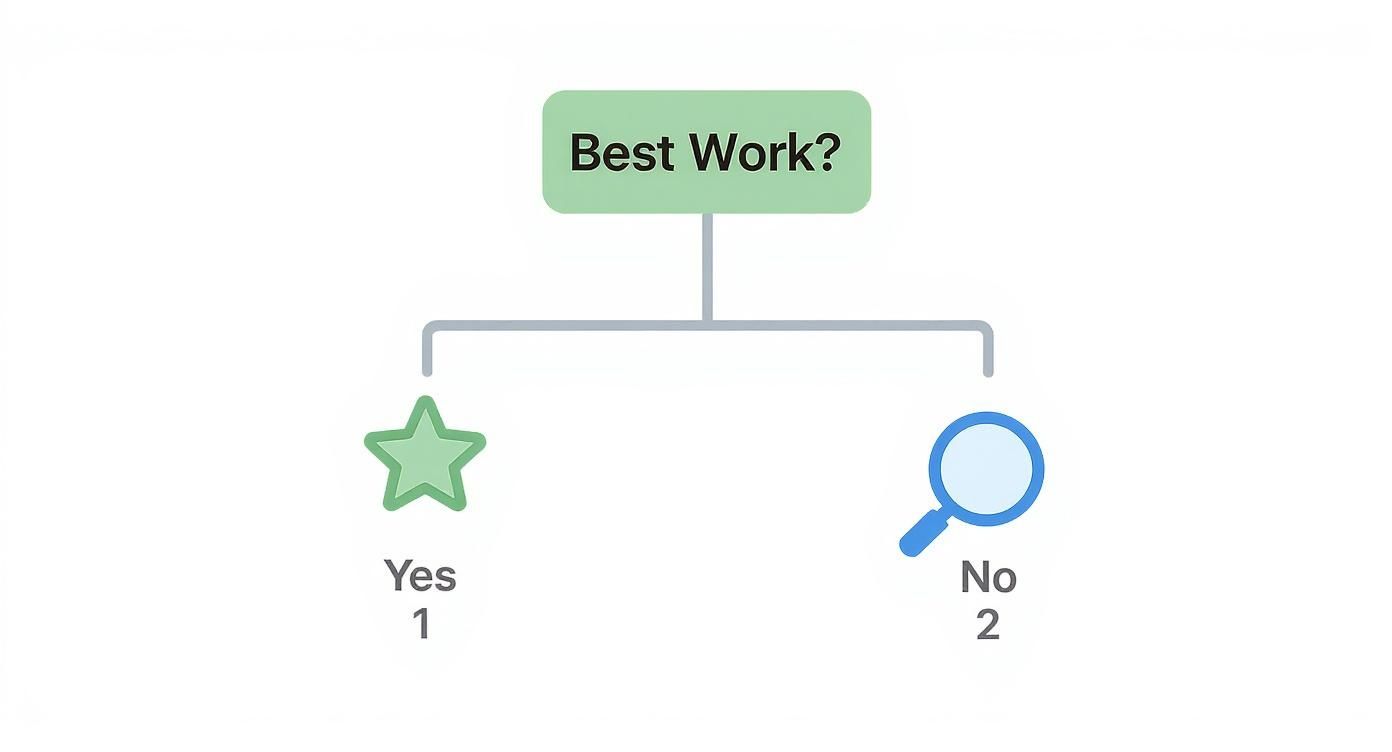
This visual guide reinforces a core principle I always stress: your portfolio should be a highlight reel. Focus exclusively on the work that best proves your skills and potential.
Leveraging Professional Networks
Finally, don’t sleep on the platforms you already use every day. LinkedIn, for instance, is way more than just an online resume now. The "Featured" section on your profile is prime real estate to add project links, upload media, and create a mini-portfolio.
While it won't give you the design freedom of a personal website, its reach is massive. With over 1 billion members, it’s the world’s largest professional network. Adding your work directly to your profile makes it dead simple for recruiters who find you there to see what you’re capable of in a single click. Think of it as your professional storefront—it’s the first place many employers will look.
The online learning industry in the US alone was worth $100 billion in 2022, and with more than one-third of American students now taking at least one online course, digital portfolios are becoming the new standard for everything from assignments to final assessments.
Ultimately, the best strategy is often a hybrid one. Use a dedicated website as your main gallery, but use platforms like LinkedIn and Behance as outposts to drive traffic back to it. By choosing the right mix of tools, you can ensure your hard work gets the audience it truly deserves.
How to Share Your Portfolio for Maximum Impact
You’ve poured your heart and soul into building a portfolio that truly represents you. That’s a huge accomplishment, but it's only half the battle. Now, you have to get it in front of the right people.
Think of your portfolio link as your professional calling card. By weaving it into every professional touchpoint, you turn a static webpage into a dynamic career-building tool that works for you around the clock.
Here are the must-have spots to plant your portfolio link:
- On Your Resume: Don't bury it. Place a clean, customized URL right in your header, next to your email and phone number. Recruiters should be able to click it without a second thought.
- In Your Email Signature: This one is easy to overlook but incredibly powerful. Add a simple, direct line like "View My Work" or "See My Projects" linked to your portfolio.
- On Professional Profiles: Your LinkedIn "Featured" section is prime real estate. Same goes for your GitHub bio or any other platform relevant to your field. It adds instant credibility.
- Within Job Applications: Whenever a form has a spot for a website or additional information, use it. This gives context to your application and backs up the claims you make in your cover letter.
The goal is simple: make your work impossible to miss.
Templates for Smart Outreach
When you're reaching out to mentors, recruiters, or potential connections, a generic message just won't cut it. My advice? Keep your outreach short, personal, and to the point—under 150 words is a good rule of thumb.
- The Hook: Start by mentioning something specific about their work or a recent accomplishment. This shows you've done your homework and aren't just spamming contacts.
- The Pitch: Briefly introduce yourself and connect your work to their interests. Mention one specific project by name, state the problem you tackled, and invite them to see the full story in your portfolio.
- The Ask: End with a clear, low-pressure call to action. Something like, “I’d be grateful for any feedback you have on my portfolio” works wonders.
A thoughtful, personalized message can boost your response rates by over 25%. It shows respect for their time and makes you memorable.
Frame Your Projects Like a Pro
The difference between a good portfolio and a great one is storytelling. Anyone can show a final product, but experts show the why and the how.
For each project, build your narrative around these four key elements:
- The Challenge: What was the problem? Set the scene and explain the context.
- Your Process: How did you tackle it? Walk them through your steps, mentioning the tools and techniques you used.
- The Results: What was the outcome? Use numbers and concrete metrics wherever possible. Did you increase efficiency, boost engagement, or improve a specific metric?
- Your Learnings: What did you take away from the experience? This shows self-awareness and a commitment to growth.
By framing each piece this way, you’re not just showing what you did; you’re demonstrating how you think. That's what gets you hired.
Ready to nail that first impression? Check out our guide with great examples of a portfolio cover page.
Get Creative With Your Link
Don't just stop at the basics. Think about where your ideal employer or client spends their time.
- Got a career fair or networking event coming up? Put a QR code on your business card that links directly to your portfolio.
- Create a short video walkthrough of your favorite project and share it on LinkedIn or Twitter.
- Are you active in any online communities or forums? Add your portfolio link to your profile signature.
The more strategically you place your link, the more doors you'll open.
Track Your Efforts and Optimize
Once you start sharing, you need to pay attention to what's working. Most portfolio platforms have built-in analytics that show you who's clicking, where they're coming from, and which projects get the most attention.
Check your analytics once a month. This isn't about vanity; it's about strategy.
- Use UTM parameters to create unique links for different channels (like one for your resume, another for LinkedIn). This tells you exactly which sources are driving traffic.
- Experiment with timing. I've found that sharing on social media on weekdays during business hours can lead to a 35% higher click-through rate.
- A/B test your outreach messages. Try different subject lines or calls to action to see what gets the best response.
Data tells a story. If you notice one project is getting a ton of views, maybe that's the one you should feature more prominently. This iterative process shows that you're not just a student—you're a strategic thinker.
Common Questions About Building a Student Portfolio
Building your first portfolio can feel like staring at a blank page. A flood of questions and a healthy dose of self-doubt usually follow. It’s totally normal to wonder if your work is "good enough" or if you even have anything worth showing.
I’ve heard these same worries from countless students, and I'll let you in on a little secret: the answers are way simpler than you think.
Let's walk through some of the most common hurdles I see students face. Think of this as your personal FAQ, designed to help you push past that feeling of uncertainty and start building with confidence. Getting these things straight from the get-go makes the whole process feel less like a chore and more like an opportunity.
What If I Don't Have Enough Professional Work?
This is it. The big one. The number one fear I hear from students, and it's a classic case of imposter syndrome. It's also built on a total misconception about what a student portfolio is for.
A student portfolio isn't supposed to look like a highlight reel from a ten-year career. Its entire purpose is to show your potential and your process.
Hiring managers looking at a student's portfolio aren't expecting a list of paid clients. They're looking for proof of your skills, your curiosity, and how you tackle problems.
Your portfolio's value comes from demonstrating how you think, not from a list of professional clients. Class projects, personal experiments, and academic research are the perfect raw materials.
You just need to redefine what "work" means in this context. It can be:
- Your best class projects: That final paper you poured your soul into, the detailed lab report, or the group presentation that earned top marks are all fair game.
- Personal passion projects: Did you start a blog, build a simple app to solve an annoyance, or create fan art? This stuff shows initiative and genuine interest.
- Detailed case study analyses: Even if it's a theoretical project from class, writing a detailed breakdown of your approach shows off your critical thinking.
The key is to wrap a short narrative around every piece you include. What was the goal? What steps did you take? What was the outcome, and what did you learn? That story is often more compelling than the project itself.
How Do I Make a Portfolio for a Non-Creative Field?
Let's clear this up right now: portfolios aren't just for artists and designers. In fact, I believe they can be an absolute secret weapon in analytical fields like finance, engineering, or the sciences because they provide hard proof of skills that are otherwise just words on a resume.
The trick is to shift your focus from visual flair to showcasing evidence.
Your portfolio becomes a library of your analytical and technical chops. It proves you can take the complex theories from your coursework and apply them to solve real-world problems.
Here are a few ideas to get the wheels turning:
- For a finance student: Include a stock pitch presentation, a detailed financial model you built in Excel (using public data), or an analysis from a case study competition.
- For a science student: Feature an in-depth lab report, a research symposium poster, or a data analysis project you completed using Python or R.
- For an engineering student: Showcase CAD drawings, a project management plan for a team assignment, or a simulation you ran to test a concept.
Presentation still matters, though. Host these projects on a clean, professional website. I'd organize them by the skills they demonstrate—think "Data Visualization," "Financial Analysis," or "Mechanical Design." This structure makes it incredibly easy for an employer to see exactly what you're capable of. Trust me, a well-organized portfolio in a technical field is rare and immediately impressive.
How Often Should I Update My Portfolio?
Think of your portfolio as a living document, not a one-and-done project. An out-of-date portfolio is a huge missed opportunity. My go-to advice? Set a recurring calendar reminder to review it at the end of every single semester.
The timing is perfect. Your best new work is still fresh in your mind, which makes writing those insightful project descriptions a breeze. It’s also a fantastic moment for a little self-reflection. Ask yourself a simple question: does this new project do a better job of showing a key skill than an older one? If the answer is yes, make the swap.
This habit does more than just keep your content current. It sends a powerful signal to employers that you are actively invested in your own growth and are constantly leveling up your skills.
And of course, always do a quick refresh right before you start applying for internships or jobs. This is your chance to tweak your "About Me" section and project descriptions to align perfectly with the specific roles you want. A little customization can make a massive difference—some sources even suggest it can increase callback rates by as much as 50%.
Feeling ready to turn your experience into a standout website? Fantastic Portfolios uses AI to transform your resume into a polished, professional portfolio in seconds. Stop worrying about design and start showcasing your work today. Get started for free at https://fantasticportfolios.com.