Build a Professional Portfolio That Gets You Hired
A professional portfolio is so much more than just a folder of your old projects; think of it as the visual story of your career. It’s the tangible proof that backs up all those skills you list on your resume, letting you show potential employers what you can do, not just tell them. I've personally seen a well-crafted portfolio make the difference between a candidate being "interesting" and being "the one we have to hire."
Why a Professional Portfolio Is Your Ultimate Career Tool
Let's be real: resumes can feel pretty flat. They have to squeeze your complex skills and hard-won victories into a few dry bullet points. I once landed a huge client not because of my resume, but because my portfolio walked them through the exact process I used to solve a problem just like theirs. That kind of direct, visual proof is what seals the deal.
In today's job market, a killer portfolio isn't just for creatives anymore. It’s a game-changing asset for project managers, marketers, developers—you name it. In fact, a recent survey found that 56% of hiring managers now prefer candidates who can provide a portfolio, regardless of their industry. It’s the difference between saying you’re a great project manager and showing off a finished project with a clear timeline, the challenges you tackled, and the successful outcome.
Cut Through the Noise
Recruiters are swamped. Studies show they spend an average of just six to seven seconds scanning a resume. In that tiny window, a list of responsibilities can easily blur into the background. A link to a polished portfolio, on the other hand, is an invitation to see your work in action. It's a welcome interruption.
A portfolio gives you undeniable, tangible proof of your abilities. It closes the gap between the claims you make on paper and the real-world application of your skills. This is your chance to nail the classic "show, don't tell" hiring principle and immediately stand out from a sea of text-based applications.
This diagram breaks down how a portfolio helps you grab a recruiter's attention, prove your skills, and get that competitive edge.
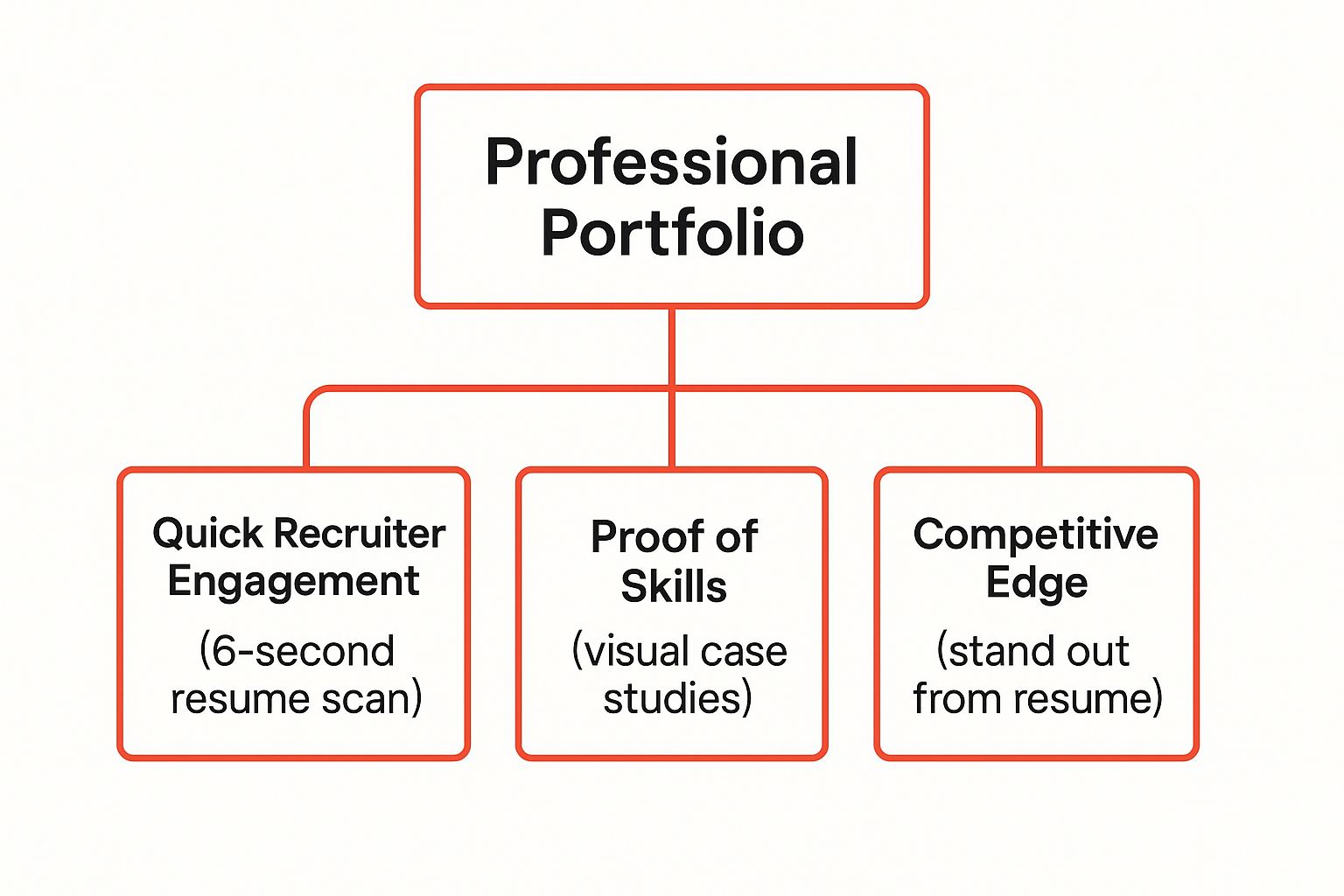
As you can see, a professional portfolio transforms your resume from a static piece of paper into an engaging, evidence-backed story of your career.
Build Your Professional Brand
Your portfolio is a cornerstone of your digital identity. It's a huge piece of the puzzle when it comes to building a strong online presence that works for you around the clock. More importantly, it puts you in control of your own professional narrative. Unlike a static PDF, it’s a living document that grows right alongside your career. You can update it instantly with new projects, skills, and wins.
Your portfolio is your personal marketing engine. It’s a curated space where you can show off not just what you’ve done, but who you are as a professional—your style, your process, and what makes you uniquely valuable.
This living document offers some major advantages:
- Demonstrates Growth: It clearly shows your career trajectory and how you’ve leveled up your skills over time.
- Highlights Versatility: You can showcase a wide range of projects that would never fit neatly onto a one-page resume.
- Builds Credibility: Nothing builds trust like real-world proof. Testimonials, case studies, and hard numbers add layers of credibility that a resume simply can't.
Ultimately, keeping a sharp professional portfolio means you're always ready for what's next, whether that’s a new job, a freelance gig, or a big promotion. To get started, check out our complete guide on creating an online portfolio that truly gets you noticed.
The Core Elements of a Winning Portfolio
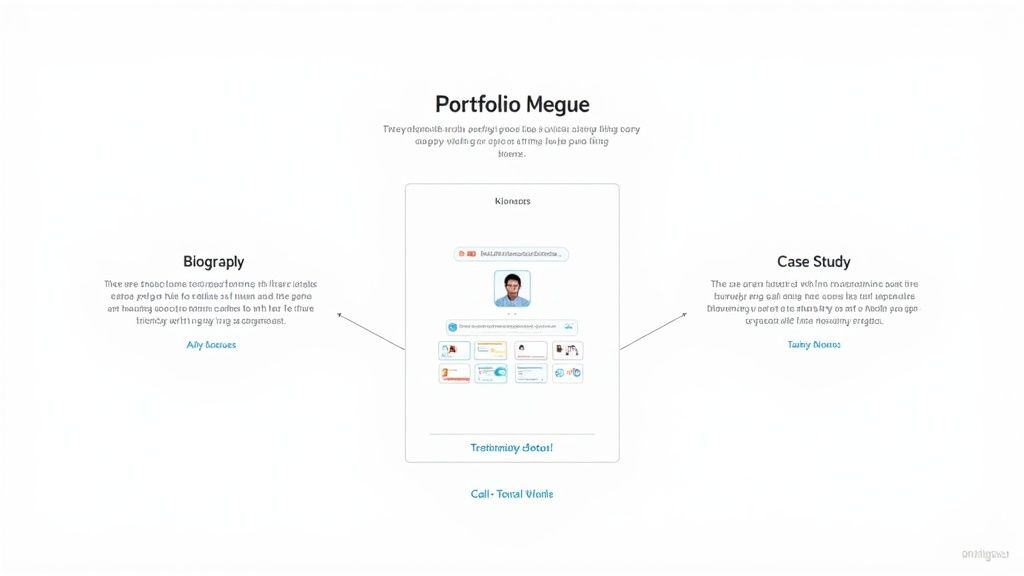
Putting together your first portfolio can feel a little intimidating, like you’re staring up at a huge mountain. But it’s really just a series of smaller, totally manageable hills. A great portfolio isn't just a gallery of pretty pictures; it’s a strategic tool that guides a recruiter or client through your professional story.
The whole point is to structure your work in a way that answers their questions before they even think to ask them. I learned this the hard way. Early in my career, I started adding a short, personal story to each of my projects—outlining the challenge, my approach, and the actual results. The difference was night and day. My client inquiries shot up by nearly 50%.
This framework gives you that same blueprint, breaking down the essentials that elevate a simple collection of work into a compelling reason to hire you.
Your Professional Biography: The Hook
Think of your bio or "About Me" page as the opening scene of your personal movie. It has to hook the audience immediately. This is not the place for a dry, third-person summary of your resume. This is your chance to show some personality and frame your expertise.
Your bio should quickly answer a few key things for anyone reading it:
- Who are you as a professional?
- What unique skills or perspectives do you bring to the table?
- What gets you excited about your field?
Keep it brief, be authentic, and stay focused on the value you deliver. It's your first—and best—shot at making a genuine human connection in a sea of generic profiles. Your first page is your digital handshake, and you can find more inspiration in these examples of a portfolio cover page.
Curated Projects and Case Studies
This is the heart and soul of your portfolio—the hard proof of what you can do. Notice the keyword here is curated. A common mistake is to throw in every single project you've ever worked on. Don't do that. Instead, cherry-pick your best work that directly speaks to the kinds of roles or clients you want to attract.
For each project, you need to go deeper than just showing the finished product. An effective portfolio tells the story behind the work, turning a simple work sample into a persuasive case study.
A case study doesn't just display your work; it demonstrates your thinking. It walks a potential employer through your problem-solving process, showing them exactly how you create value.
To make each project compelling, frame it with these key components:
- The Challenge: Briefly set the scene. What was the problem or goal?
- Your Role and Process: Get specific about what you did. What were your responsibilities and the steps you took to get there?
- The Solution and Results: Show off the final outcome and—this is crucial—back it up with numbers. Did you increase efficiency by 20%? Boost engagement by 300%? Hard data makes your impact undeniable.
Showing your strategic thinking through well-told case studies is what separates a good portfolio from a great one. To see how others have successfully framed their work, check out these examples of professional case studies.
A well-structured portfolio tells a story, and every section plays a critical role. Here's a quick breakdown of what to include and why it matters.
Key Portfolio Components and Their Purpose
| Component | Purpose | Pro Tip |
|---|---|---|
| Professional Biography | To establish your identity, personality, and unique value proposition right from the start. | Ditch the corporate jargon. I've found that writing in your natural voice creates a much more authentic connection. |
| Curated Case Studies | To provide concrete evidence of your skills, process, and ability to deliver tangible results. | For each project, focus on the "why" and "how," not just the "what." Explain your thought process. |
| Skills & Expertise | To give a quick, scannable overview of your technical abilities and core competencies. | Go beyond just listing software. Include soft skills like "Client Communication" or "Project Management." |
| Testimonials | To build trust and credibility through third-party validation from clients or managers. | Ask for testimonials that highlight specific skills or outcomes, not just generic praise like "great to work with." |
| Call to Action (CTA) | To guide the visitor on what to do next, converting them from a passive viewer into an active lead. | Be direct and clear. Use action-oriented language like "Let's Talk," "View My Resume," or "See My Services." |
Each of these elements works together to build a powerful and persuasive narrative about you and your work.
Testimonials and a Clear Call to Action
Nothing sells your skills quite like social proof. Sprinkling in a few testimonials from past clients, bosses, or coworkers adds a layer of credibility that you simply can't create on your own. I've found that a couple of glowing quotes can powerfully back up the claims you make and build instant trust. In fact, websites that feature testimonials often see a conversion lift of over 34%.
Finally, every portfolio needs a destination. After someone has read your story, been impressed by your work, and been convinced by your testimonials, what’s next? Don't make them guess.
Your call to action (CTA) should be impossible to miss. Whether it’s “Contact Me for a Consultation,” “Download My Resume,” or “Let's Connect on LinkedIn,” you need to guide them to the next logical step. This one simple element can be the difference between someone just browsing and someone reaching out.
Tailoring Your Portfolio to Your Industry

Throwing a one-size-fits-all professional portfolio at every job opening is a massive missed opportunity. Think of it like a key; you wouldn't use your house key to start your car. The same logic applies here. The portfolio that makes a creative director swoon will likely get a flat "no" from a hiring manager in software engineering.
Customization isn't just a bonus—it's everything. It's the core of making a real impact.
I remember my early days, sending the same generic portfolio to every single opening. The response? Absolute crickets. It wasn't until I started obsessively researching each industry, and even each company, that things started to click. Tailoring my projects and the way I talked about them to mirror what they cared about was what finally got me noticed.
The Developer's Showcase
For anyone in tech—especially software developers and engineers—a portfolio is less about visual fireworks and all about functional proof. It’s a direct window into how you code, how you think, and how you solve tough problems. From my experience talking to tech hiring managers, they're looking for clarity and substance.
A hiring manager in this space isn't looking for flair. They want to see your logic, your clean code, and your ability to work with a team.
Here’s exactly what they’re scanning for:
- GitHub Profile: This is non-negotiable. Your GitHub is your living, breathing resume. It shows off your contribution streaks, personal projects, and any open-source work you've done.
- Live Demos: Nothing beats a link to a deployed application. It’s hard proof that you can take a project from an idea all the way to a functional product.
- Code Snippets: Don't be afraid to include snippets of your best, most elegant code right inside your case studies. Just be sure to explain the problem you solved with that specific block.
- Technical Blogs: Writing about a complex technical challenge you wrestled with and conquered shows a deep understanding and proves you can communicate complex ideas clearly.
The Creative's Visual Story
For designers, writers, photographers, and marketers, the portfolio is a direct reflection of your aesthetic and strategic mind. In these fields, how you present the work is just as important as the work itself. I've seen brilliant work get ignored because it was presented in a visually cluttered or poorly written portfolio.
Creatives need to focus on telling a compelling story. A marketing strategist, for instance, shouldn't just say a campaign was "successful." They need to show it, with clear data visualizations proving the ROI. You need to back it up with a chart showing a 25% increase in conversions.
If you're crafting a portfolio for a creative role, our guide on building a standout product designer's portfolio has more specific ideas to get you started.
Your portfolio is your first and most important piece of work. For a creative professional, it demonstrates not just your skill in your craft, but also your ability to curate, present, and sell an idea—starting with yourself.
The Business Professional's Case for Value
So what about project managers, consultants, or data analysts? When your role isn't inherently visual, your portfolio becomes a showcase of results and process. It’s your chance to translate your skills into tangible business value.
Your goal here is to build a collection of case studies that prove your impact. Think about projects where you improved efficiency, cut costs, or drove revenue. Use hard metrics, clear timelines, and glowing testimonials to build an undeniable case for your expertise.
By aligning your portfolio with the specific expectations of your target industry, you stop being just another applicant. You become the obvious, standout solution to their problems. That targeted approach is what turns a good professional portfolio into a truly career-defining tool.
Choosing the Right Tools to Build Your Portfolio

Let's get one thing straight: you absolutely do not need to be a web developer to create a stunning professional portfolio. I remember spending an entire month trying to code my first site from scratch—it was a disaster and a colossal waste of time. The good news is, the tools we have today make building a polished online presence faster and easier than ever.
This section is your practical guide to the modern portfolio-building toolkit. We'll walk through the best platforms for different professions, breaking down what they’re good at and where they fall short. The goal is simple: find the right tool for you, get a professional-looking site live in a single weekend, and get back to what you do best.
Platform-Specific Portfolios for Niche Industries
For certain creative and technical fields, there are dedicated platforms that double as community hubs. They’re often the industry standard. If you're a designer or developer, starting here is the quickest way to get your work in front of the right eyeballs.
- For Creatives (Behance, Dribbble): Think of a platform like Behance as part portfolio, part social network. It's a fantastic space for visual pros—graphic designers, illustrators, and UX/UI designers. It’s free and gives you immediate exposure to a massive community of peers and recruiters. In fact, over 70% of creative professionals use platforms like these to showcase their projects.
- For Developers (GitHub): For any software developer, your GitHub profile is your portfolio. It’s where you show your actual code, your contribution history, and your problem-solving skills in action. A clean, well-maintained GitHub is often more valuable to a tech recruiter than the flashiest custom website.
All-in-One Website Builders
If you're a marketer, consultant, project manager, or just want more creative control, a general website builder is your best bet. These tools give you professional templates and drag-and-drop editors, letting you build a fully custom site without touching a line of code.
Think of a website builder as your digital command center. It gives you the power to control your narrative, combine different types of projects, and create a unique space that is entirely your own.
Here’s a quick rundown of some of the most popular options out there:
| Tool | Best For | Ease of Use | Customization | Cost |
|---|---|---|---|---|
| Squarespace/Wix | Professionals wanting beautiful, robust sites. | Easy | High | $$ (Subscription-based) |
| Carrd | Simple, one-page portfolios. | Very Easy | Medium | $ (Very affordable) |
| WordPress.com | Those who want ultimate flexibility. | Medium | Very High | Free, with paid upgrades |
| Fantastic Portfolios | Professionals who need an AI-powered site fast. | Extremely Easy | High (Template-based) | Free, with paid upgrades |
Each of these tools can help you build an incredible professional portfolio. For those in the creative world, we’ve put together a more detailed guide on choosing the perfect graphic designer portfolio site with more tailored advice.
The Rise of AI Portfolio Builders
The newest and, frankly, fastest option on the scene is the AI-powered portfolio builder. Tools like Fantastic Portfolios are taking this to the next level by using your existing resume to generate an entire website for you in seconds. I tested this myself by uploading my own PDF resume, and it had a structured, professional-looking site ready for me in under a minute.
This approach is a lifesaver for anyone who's short on time or feels paralyzed by endless design choices. The AI handles the structure, layout, and even helps polish your project descriptions, so all you have to do is focus on curating your best work. It's a genuine game-changer for building an effective professional portfolio with minimal friction.
Connecting Your Portfolio to Broader Market Trends
Your professional portfolio is so much more than a scrapbook of past projects. It’s a strategic tool, and when you use it right, it proves you understand exactly where your industry is headed. This is what we call commercial awareness—a quality that makes you far more valuable than someone who can only talk about their own skills.
You're essentially connecting the dots for a potential employer, showing them you’re not just a capable professional but a forward-thinking one.
I once had a colleague who always seemed to land the coolest, most high-stakes projects. His secret wasn't just raw technical skill; it was his uncanny ability to frame everything he did within the company's biggest challenges. His portfolio didn't just say, "Here's what I built." It screamed, "I built this to solve this specific market problem," and that made all the difference.
Aligning Your Work with What Matters Now
To get your portfolio to land with real impact, you need to have your finger on the pulse of the macro trends shaping your field. What are companies in your industry obsessed with right now? Is it all about operational efficiency? Data-driven decision-making? Maybe sustainability is the new bottom line.
Once you pinpoint these trends, you can strategically feature the projects that speak directly to them.
For example, if you're a project manager targeting an industry that's tightening its belt, you’d be wise to showcase case studies where you brought a project in under budget or streamlined a process to save the company a boatload of money.
Your portfolio should act as a bridge between your personal accomplishments and the broader economic conversation. It shows that you're not just capable of doing the work but that you understand why the work matters in the current climate.
This kind of strategic framing shows you’re a commercially savvy pro who can start contributing to a company's most urgent goals from day one.
Demonstrating Adaptability in a Shifting Economy
The professional world is always in flux, and your portfolio is the perfect place to prove you can roll with the punches. Showing how you navigate change and deliver results—even when things get chaotic—is an incredibly powerful selling point. This is especially true when you zoom out to the wider economic picture.
Take the global private markets, for instance. They've seen some mixed signals recently. Even with fundraising dipping to its lowest point since 2016, capital deployment has actually grown, which shows investors are still resilient. This signals a market adapting to big structural shifts like higher interest rates and a laser focus on operational transformation. Highlighting projects where you drove innovation or boosted efficiency demonstrates you have the exact skills needed in this dynamic environment. You can learn more about these private market findings from McKinsey to get the full picture.
When you frame your work this way, your portfolio stops being a simple showcase. It becomes a compelling argument for your relevance and future value. If you're looking to tailor your work for a corporate audience, check out our guide on creating a business portfolio. It's not just about what you've done; it's about proving you're ready for what’s next.
Still Have Questions About Professional Portfolios?
Even with a solid plan, diving into your first professional portfolio can feel like you're missing a few puzzle pieces. That’s perfectly normal. Over the years, both in building my own portfolios and guiding others, I've noticed the same questions pop up again and again.
Let's clear up some of that confusion. Answering these common questions will give you the confidence to build a portfolio that truly works for you.
How Many Projects Should I Include?
This is a big one, but the answer is simple: quality will always, always trump quantity. Forget about creating a massive archive of everything you've ever touched. That's not the goal.
My personal rule of thumb is to showcase 5-10 of your absolute best and most relevant projects. Think of it as your highlight reel, not the entire game tape. You want a focused, curated collection where each project tells a compelling story about your skills and lines up with the kind of job you’re after. A few detailed case studies are infinitely more powerful than a sprawling gallery with no context.
Each project should earn its spot. It needs to prove a specific skill or show off a successful outcome that a future employer would find valuable.
Do I Need a Portfolio If I’m Not in a Creative Field?
Yes, absolutely. The old idea that a professional portfolio is just for artists and designers is completely outdated. A portfolio is a game-changer for professionals in any role because it’s all about one thing: tangible proof.
It’s your chance to show, not just tell. For instance:
- A project manager can display detailed project plans, timelines, and case studies on final outcomes.
- A data analyst can feature insightful reports, interactive dashboards, and compelling data visualizations.
- An educator can share innovative lesson plans, curriculum samples, and evidence of student growth.
No matter your industry, the purpose is the same. You're turning an abstract claim on your resume—like "strong analytical skills"—into a concrete, verifiable fact that no one can argue with.
How Often Should I Update My Professional Portfolio?
Your portfolio should be a living, breathing document, not a static snapshot that collects digital dust. I make it a habit to give mine a quick review and refresh every quarter, even if I’m perfectly happy in my current role.
This regular check-in does a couple of important things. It allows you to add new projects while the details and metrics are still fresh in your mind. It's also the perfect time to prune older work that no longer reflects your current career goals.
Keeping your portfolio current means you’re always ready when an unexpected opportunity comes knocking. More importantly, it keeps your professional story sharp, relevant, and pointed toward your future. It's a small time investment that pays off big in career readiness.
Ready to build a standout professional portfolio without all the hassle? With Fantastic Portfolios, our AI-powered builder can turn your resume into a polished, professional website in under a minute. Stop wrestling with templates and start showcasing your work. Create your free site today.