Build a Standout Architecture Portfolio
Think of your architecture portfolio as your single most important career tool. It's more than just a collection of your best work; it's your visual resume, a highlight reel of your skills, and a narrative of your unique design philosophy all rolled into one. I still remember the weeks I spent agonizing over my first one, trying to perfectly balance academic projects with my own emerging style.
What I learned is that a portfolio isn't a passive gallery. It's a strategic story you tell to land your next big opportunity.
Your Portfolio Is Your Professional Story

Putting together an architecture portfolio can feel like a monumental task, I get it. But its power lies in showing how you think, solve problems, and approach the entire design process. In such a competitive field, a standout portfolio is what gets you in the door and starts conversations with the firms you've been dreaming of working with.
This is more crucial than ever. The total number of licensed architects in the United States recently saw its first significant decline in years, dropping by 4% to 116,000. This shift, largely due to retiring baby boomers, is creating a massive opening for emerging architects. A strong, distinct professional identity is no longer a "nice-to-have"—it's essential for capturing these new opportunities.
Define Your Unique Identity First
Before you even touch a single project file, you need to step back and define who you are as a designer. What's your unique point of view? What drives your creative decisions? Answering these fundamental questions gives your portfolio a theme, a narrative thread that ties everything together.
From personal experience, I can tell you that without this, your portfolio risks feeling like a random assortment of images rather than a cohesive, intentional presentation.
Your portfolio should answer the question, "Why you?" before the interviewer even has to ask. It’s a silent presentation of your value, your process, and your potential contribution to a firm's vision.
This narrative-driven approach is the core of any effective professional portfolio that truly connects with hiring managers. Take some time to think about what makes your work yours:
- Your Design Philosophy: Do you lean toward sustainability, human-centric design, or cutting-edge tech integration? Make that clear right from the start.
- Your Core Skills: Are you a wizard with conceptual sketching, a master of BIM, or an expert in photorealistic rendering? Let your portfolio be the proof.
- Your Career Goals: Is your eye on a large commercial firm or a small, design-focused boutique? Your story needs to be tailored for that specific audience.
Once you establish this foundation, every decision—from which projects to include to how you lay out each page—will serve a clear purpose. You'll be building a powerful and compelling story about who you are as an architect, one page at a time.
Building a narrative is all about connecting the dots for the reader. The table below breaks down the core elements that help you do just that.
Core Elements of a Narrative-Driven Portfolio
| Element | Objective | Actionable Tip |
|---|---|---|
| Theme | Establish a unifying idea that reflects your professional identity. | Start your portfolio with a concise statement defining your design philosophy or mission. |
| Curation | Select only the projects that support your central theme and goals. | For each project, ask: "Does this advance my story?" If not, leave it out, no matter how good it is. |
| Flow | Arrange projects in a logical sequence to guide the reader. | Organize projects chronologically to show growth or thematically to highlight specific skills. |
| Context | Explain the "why" behind your design choices for each project. | Use short, impactful project descriptions focusing on the problem, your process, and the outcome. |
By weaving these elements together, your portfolio stops being a simple list and starts telling the compelling story of your professional journey.
Curating Projects for Maximum Impact

The single biggest mistake I see architects make is trying to cram everything they've ever worked on into one document. Resist this temptation with everything you have. A powerful architecture portfolio is an exercise in strategic curation, not a display of sheer volume.
I’ve seen it happen time and again: a portfolio with 5-7 exceptional, well-documented projects consistently blows a 20-project behemoth out of the water. Your goal isn't to create a comprehensive archive of your life's work. It's to build a compelling case for why you are the right person for a specific opportunity.
Quality, not quantity, is the name of the game.
Think Like a Curator, Not a Collector
Your job is to guide the viewer through a masterfully selected collection of your best work, with each project serving a distinct purpose. Think of it like a brand's product lineup, where every item has a defined role. A collector saves everything; a curator selects only the pieces that tell a cohesive and powerful story.
Start by laying out all your potential projects—from academic work and competitions to professional commissions. Now, get ruthless and evaluate each one against a strict set of criteria:
- Narrative Fit: Does this project align with the professional story you’re trying to tell? If you're positioning yourself as a sustainable design expert, that purely commercial, energy-intensive high-rise probably isn't helping your case.
- Skill Demonstration: What specific skill does this project put on a pedestal? Maybe one showcases your mastery of Revit, another your conceptual sketching, and a third your expertise in parametric design.
- Target Audience: Is this project relevant to the firms you're actually targeting? If you're applying to firms that specialize in bespoke residential architecture, your large-scale urban planning project might be less impactful.
This selective process is absolutely critical. The principles of strategic curation seen in product design are highly applicable here. Just as a product designer showcases only their most relevant case studies, you should focus on your most impactful architectural work. To see how other creative fields approach this, check out our guide on building a compelling product designer's portfolio.
Sequencing for a Powerful Narrative Flow
Once you've cherry-picked your best 5-7 projects, the next step is sequencing them. How you order your work creates a narrative journey that can either captivate or confuse the hiring manager. Don't just list them chronologically and call it a day.
Start with your strongest, most impressive project. This is your "wow" moment. You need to grab their attention immediately and set a high bar for what's to come.
After a powerful opening, you can arrange the next few projects to demonstrate your range and versatility. Consider a structure that flows naturally and tells a story about your growth as a designer:
- Open with a showstopper. This should be your most complete, visually stunning, and conceptually interesting work.
- Follow with variety. Showcase projects that highlight different skills or scales. For instance, move from a detailed residential project to a conceptual public space.
- Reveal your process. Include a project that really emphasizes your problem-solving abilities. Show the messy stuff—early sketches, diagrams, and process models—to give insight into how you think.
- Close with another banger. End on a high note, leaving a lasting impression of your talent and potential.
This thoughtful arrangement transforms your portfolio from a simple collection into a guided tour of your capabilities. It shows you're not just a drafter; you're a designer who can think, communicate, and create.
Designing Your Portfolio Layout and Narrative
You've picked out your best projects. Now comes the fun part: bringing them to life on the page. Think of your portfolio's design as an extension of your architectural style—it should be clean, intentional, and purposeful. This isn't just about making things look pretty; it's about using graphic design to tell a compelling story about your work.
I've seen countless portfolios over the years, and the most effective ones always use design to enhance the work, not compete with it. A classic rookie mistake is cramming too much onto a single page. It’s overwhelming for a hiring manager who might only give your portfolio five minutes of their time, if you're lucky. The real goal is to create a clear path for their eyes, guiding them exactly where you want them to go.
Establishing a Clear Visual Hierarchy
Visual hierarchy is simply about arranging your content so the viewer's eye is naturally drawn to the most important elements first. It’s about creating an intentional flow. Use size, color, and placement to make that happen. A huge, stunning render should be the first thing that grabs their attention, followed by smaller process sketches and short, punchy text that adds context.
Think about balance. On every single page.
White space is your absolute best friend here. It’s not empty space; it's an active design element that gives your projects room to breathe and cuts down on visual noise. A well-balanced page feels calm and confident, letting the quality of your work do all the talking.
This infographic breaks down the difference between a minimalist and a cluttered layout. The numbers speak for themselves.
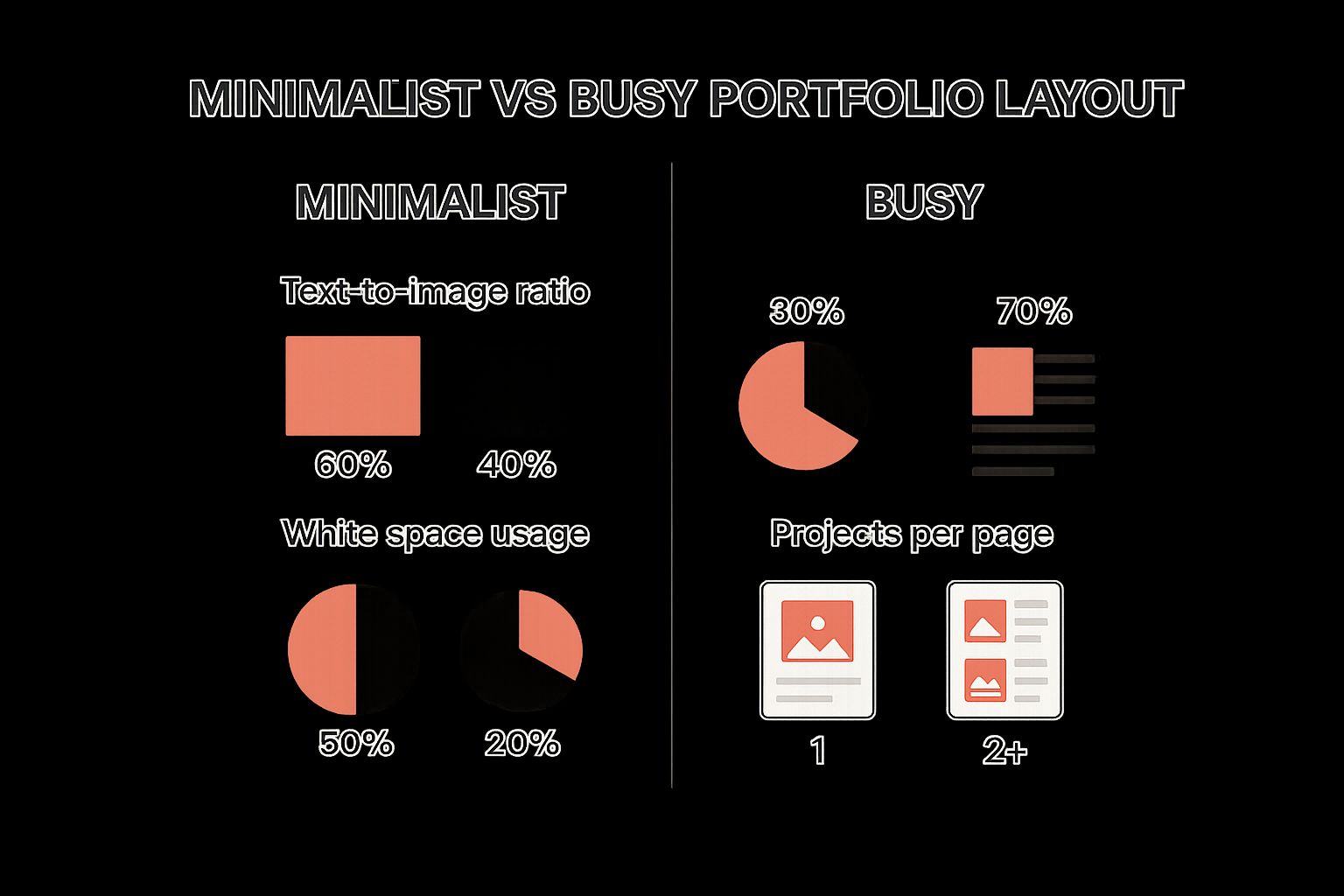
As you can see, a minimalist approach with fewer elements per page and plenty of white space makes each project feel more significant and memorable.
Weaving a Narrative for Each Project
Your layout is the stage; the narrative is the performance. Don't just drop in a project description and call it a day. Tell the story behind the design. The best way to do this is by showing your process—this is what gives firms a real window into how you think and solve problems.
A portfolio that only shows polished final renders is like a story that starts at the last chapter. The real value is in the journey—the initial sketches, the diagrams, the physical models—that led to the final design.
Structure each project to tell a story with a beginning, middle, and end:
- The Problem: Kick things off with a single, concise sentence that frames the project's core challenge. What were you asked to solve?
- The Process: This is where the magic happens. Use a mix of visuals—hand sketches, messy diagrams, study model photos—to walk the viewer through your journey.
- The Solution: End with a bang. Conclude with high-quality images of the final design, proving you stuck the landing.
This structure transforms each project from a simple gallery item into a compelling case study of your skills. Of course, that journey starts the moment they see the cover, so it’s worth checking out different examples of a portfolio cover page to set the right tone.
And don't forget typography. Your font choice matters more than you think. Pick something clean, elegant, and readable that complements your work without screaming for attention. When you combine a strong layout with a clear narrative, you get a portfolio that isn't just beautiful—it's persuasive.
Choosing the Right Format: Digital vs. Physical
In architecture, the "digital versus physical" portfolio debate isn't about picking a winner. It's about knowing when to use the right tool for the job. Based on my experience, the most successful architects I know don't choose one; they master both.
Think of your digital portfolio as your always-on ambassador. It’s what you attach to every email, what lives on your website, and what gets passed around an office. This is your first impression, working for you 24/7. It has to be sharp, accessible, and incredibly fast.
But never, ever underestimate the power of a physical portfolio. I've seen it happen time and again: you walk into a high-stakes interview, place a beautifully bound book on the table, and the entire energy in the room shifts. It’s a tangible expression of your work that commands respect in a way a screen just can’t.
Nail Your Digital Footprint
Your online presence is more than just a PDF. A truly professional digital strategy involves a multi-platform approach. Sites like Behance and Issuu are great for getting your work out there, but a personal website is absolutely non-negotiable. It's the one space online where you have complete control over your story.
When you’re building your site, performance is everything. A hiring manager isn't going to sit around waiting for a massive render to load. Keep your JPEGs high-quality but optimized—aim for under 500KB—to guarantee a snappy, professional user experience. For a complete walkthrough, our guide to creating the perfect online portfolio goes deep into these technical details.
The global architectural services market is expected to hit US$600.41 billion by 2032, with a massive emphasis on sustainable and innovative design. Your digital portfolio is the ideal place to showcase this expertise through detailed case studies, process videos, and even interactive models that a static format could never support.
The Lasting Power of Print
While your digital portfolio casts a wide net, your physical one is your closing argument. This is the tool you bring out for the moments that matter most, like a final-round interview or a key client pitch. The simple, tactile experience of turning a heavy page and seeing your work in high-fidelity print creates a memorable, lasting impression.
A physical portfolio isn't just a document; it's a statement. It says you care enough about your work to give it a physical form, showing a level of professionalism and dedication that sets you apart.
If you’re going to invest in print, don’t cut corners. Look into services that specialize in high-quality printed booklets and catalogs to ensure your portfolio has the impact it deserves. I always recommend a heavyweight matte paper stock—at least 100 lb—to prevent glare and give your images a rich, almost velvety finish. For binding, keep it clean and elegant with a screw-post or perfect bind that lets the work speak for itself.
Digital vs. Physical Portfolio Comparison
So, how do you decide which format is right for a specific situation? It comes down to understanding the unique strengths and weaknesses of each. Digital offers unparalleled reach and flexibility, while physical provides an unmatched level of personal impact and gravitas.
| Feature | Digital Portfolio | Physical Portfolio |
|---|---|---|
| Best For | Initial applications, online presence, broad outreach, showcasing dynamic media (video) | Final interviews, client presentations, networking events, leaving a lasting impression |
| Pros | Instantly shareable, easily updated, can include multimedia, cost-effective to distribute | High-impact, tangible, feels premium, demonstrates professionalism and craft |
| Cons | Can feel impersonal, screen quality varies, may get lost in a crowded inbox | Expensive to produce, difficult to update, impractical for mass distribution |
| Key Consideration | Optimize for speed and accessibility across all devices. | Invest in high-quality printing and materials to reflect the quality of your work. |
Ultimately, the goal is to have both a sleek, fast digital portfolio ready to send at a moment's notice and a stunning physical portfolio prepared for those critical face-to-face opportunities. Mastering both formats ensures you're ready for anything.
Showcasing Your Tech and Software Skills
The architecture industry is moving at a breakneck speed, and your portfolio has to prove you’re keeping pace. I’ve seen countless portfolios that showcase beautiful final renders but give zero insight into the technical wizardry that brought them to life. In today's market, that’s a huge missed opportunity.
Firms aren't just hiring a designer; they're investing in a tech-savvy problem-solver. Your portfolio is the perfect place to show that you're armed with the digital tools modern firms not only value but increasingly depend on.
More Than Just a Pretty Picture
Simply showing the final product isn't enough anymore. You need to pull back the curtain and reveal the software and skills behind your designs. This immediately tells potential employers you get the modern architectural workflow and can slot right into their team.
A recent benchmark survey found that about one-third of architecture professionals in the U.S. are already using AI tools. This shift is changing how projects get designed and presented, leading to more intricate and compelling work.
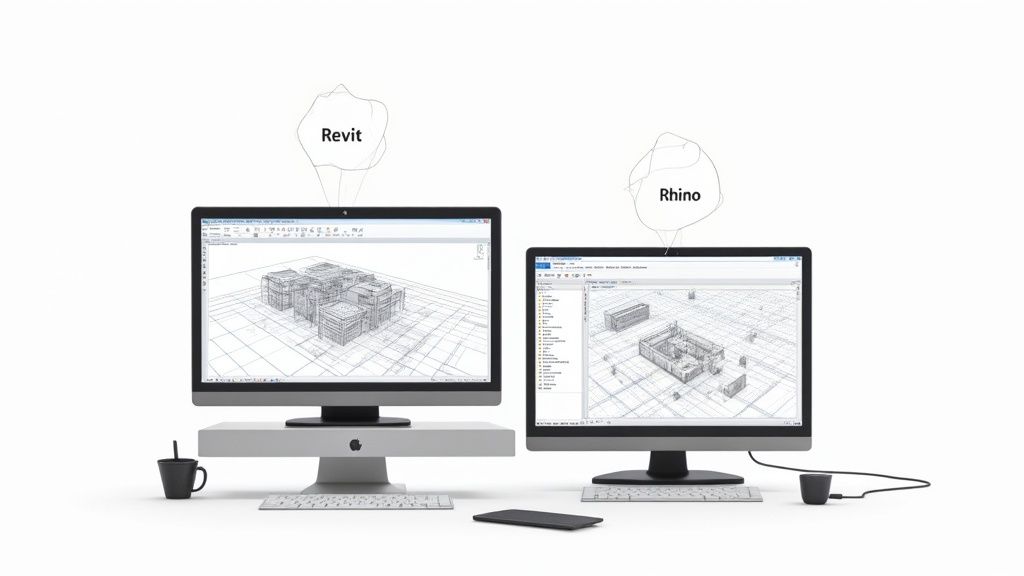
Your portfolio should explicitly state the tools you used for each project. Mentioning Revit for BIM coordination or Rhino for complex parametric forms isn't just a detail—it’s a direct signal of your technical proficiency and value.
This level of detail matters. It shows you're not just a passive user but an active participant in the industry's digital evolution.
Integrating Tech Skills into Your Narrative
So, how do you show off these skills without cluttering your layout? The key is to weave them naturally into each project’s story. Don't just slap a bunch of software logos on your resume; demonstrate their application.
- BIM and Parametric Design: Instead of just showing a final building, include a few diagrams or process images that highlight your proficiency in BIM or tools like Grasshopper. Show how you used these skills to solve a specific design challenge.
- Visualization and Rendering: Your ability to turn technical drawings into something a client can get excited about is crucial. Showcasing your skills in advanced rendered floor plan visualization proves you can bring a concept to life for stakeholders.
- VR/AR Experiences: If you have experience creating virtual or augmented reality visualizations, drop in a QR code or a link to a short video walkthrough. This is an immediate, high-impact way to prove you’re on the leading edge.
By framing your technical abilities within the context of your projects, you build a stronger, more complete narrative. This approach is a cornerstone of strong https://fantasticportfolios.com/blog/portfolio-website-design/, ensuring your digital presence is both visually impressive and rich with substance. You're not just showing what you designed; you're showing how you designed it.
Answering Your Burning Portfolio Questions
As you get closer to finalizing your architecture portfolio, a few tricky questions always seem to surface. I've heard these time and time again from designers I've mentored, and I certainly wrestled with them myself. Getting these details right can be the difference-maker for a hiring manager.
Let's dive into some of the most common ones.
How Should I Present Group Projects?
This is, without a doubt, the number one question I get. And it makes sense—so much of our work is collaborative. The trick here is to be crystal clear and honest. Don't ever try to pass off a group project as your own. The architecture world is smaller than you think, and that kind of thing will come back to haunt you.
Instead, see it as a chance to show you're a great team player. Lead by stating it was a group effort, then get super specific about your role.
- Did you take the lead on the initial concept?
- Were you the one building the BIM model in Revit?
- Did you handle all the final photorealistic renderings?
Specificity is your best friend. A simple sentence like, "Working in a team of four, I was responsible for the facade system development and all detailed construction drawings," tells a hiring manager exactly what you can do. It shows you know how to contribute effectively within a team structure.
Is It Okay to Include Academic Work?
For students and recent grads, the answer is a huge yes. Your school projects are your best shot at showing off pure, unadulterated creativity and conceptual thinking. They're free from the usual real-world constraints of budgets and clients, and they put your design process on full display.
But there's a shelf life. As you clock more professional hours, your academic work should slowly make way for real-world projects. A good benchmark: once you hit 3-5 years of solid professional experience, your portfolio should be almost entirely professional work. If you decide to keep a student project, it better be an absolute showstopper that highlights a skill none of your other work does.
Your academic work shows your potential. Your professional work shows your proof. The goal is to gradually replace the "what ifs" with the "what is."
How Often Should My Portfolio Get an Update?
Treat your portfolio like a living document, not something you create once and forget about. I always tell people to give it a refresh at least twice a year, even if you're happy in your current role. It keeps things current and means you’re always ready if an amazing opportunity pops up out of the blue.
This habit saves you from that frantic, late-night scramble when you see your dream job posted. It also gives you a chance to look at your own work with fresh eyes, making sure your portfolio is always showing off the best and most current version of you as a designer. Think of it as professional hygiene—just as crucial as keeping your software skills up to date.
Ready to build a site that tells your unique story? Fantastic Portfolios uses AI to turn your experience into a polished, professional portfolio website in seconds. Stop wrestling with layouts and start showcasing your work. Create your free portfolio today.