How to Build a Personal Brand: Quick, Practical Steps
Building a personal brand isn't about crafting some fake online persona. It’s about strategically showing the world who you are and what you do best. You define what you stand for, create content that proves your value, and build a network that genuinely supports your growth. When I first started, I thought it was just for online celebrities, but I quickly realized that when you get it right, your reputation becomes your single greatest career asset, no matter your field.
Why Your Personal Brand Is Your Greatest Career Asset
Let’s be honest, the term "personal brand" can sound a bit corporate and stuffy. When I first heard it, I pictured someone creating a slick, inauthentic version of themselves. I quickly learned it's the exact opposite—it's about clarifying and communicating who you already are. For me, that shift was a total game-changer, opening doors to consulting gigs and speaking opportunities I never thought possible.
Today, having a defined brand isn't just a nice-to-have; it's a career necessity. Your online presence is your digital handshake, making an impression long before you walk into a room. And the numbers don't lie. Research shows a staggering 98% of employers run online background checks on candidates. Even more telling, nearly half (47%) are less likely to even interview someone they can’t find online.
This infographic really drives home the core benefits.
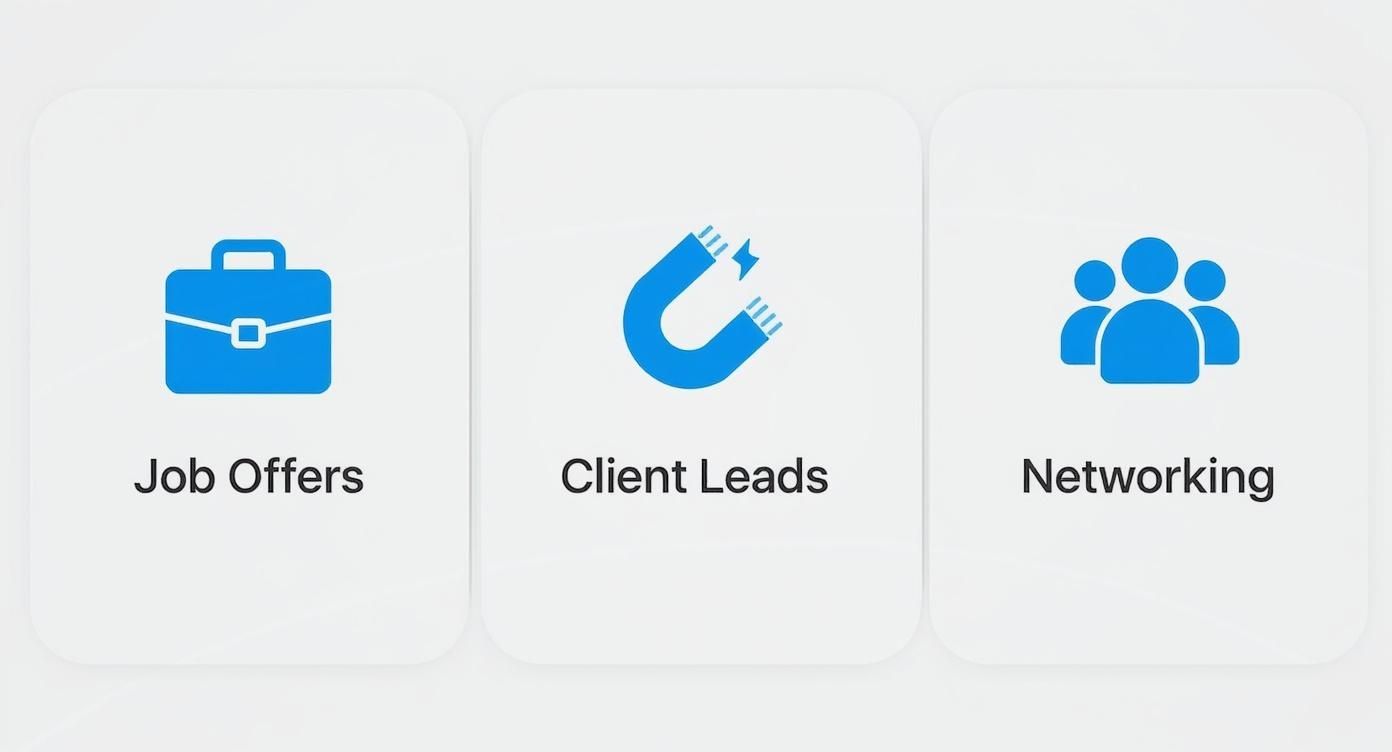
As you can see, the impact isn’t theoretical. It directly influences job offers, client deals, and the quality of your professional network.
The Impact of a Strong vs. Weak Personal Brand
To put it in perspective, let's look at a side-by-side comparison of how a strong brand can shape your career versus having a weak or nonexistent one.
| Metric | Strong Personal Brand | Weak or No Personal Brand |
|---|---|---|
| Opportunities | The best roles and projects find you. | You're constantly chasing after jobs. |
| Credibility | Instantly seen as a trusted expert. | Must prove your value from scratch every time. |
| Networking | Attracts mentors, peers, and collaborators. | Connections are purely transactional. |
| Income | Commands higher salaries and client fees. | Competing primarily on price. |
| Influence | Your voice is respected in your industry. | Your ideas struggle to gain traction. |
The difference is clear. A strategic personal brand gives you a competitive edge in every aspect of your professional life.
The Real-World Impact
Think of your personal brand as your professional reputation, amplified by the internet. It works for you 24/7, building trust with potential clients, employers, and collaborators while you sleep. I personally saw this happen when a blog post I wrote landed me a project with a dream client—they found it, read it, and reached out to me, all while I was offline.
It’s what allows you to:
- Attract the Right Opportunities: Instead of applying for dozens of jobs, the right projects and roles start coming directly to you.
- Build a Supportive Network: You connect with peers who share your values and champions who will go to bat for you.
- Command Higher Value: A strong brand almost always translates to higher earning potential, whether in salary negotiations or client proposals.
Your personal brand is the story people tell about you when you're not in the room. A deliberate strategy ensures you're the one writing that story.
Ultimately, a well-defined brand is the foundation of a modern career. It’s what you showcase in your career portfolio and what makes you stand out in a sea of qualified people. This isn't about becoming famous; it’s about becoming known for the unique value you bring to the table.
Discovering Your Authentic Brand Foundation
Before you even think about a logo or your first social media post, the real work of building a personal brand starts from within. I've seen it time and time again: the biggest mistake professionals make is jumping straight into the tactics. They get caught up in the "what" without ever defining the "why," and they end up with a brand that feels generic and is exhausting to maintain.
This is more than just "finding your niche." It’s a process of deep self-discovery.
Think of this less like a stiff corporate branding exercise and more like an honest conversation with yourself. The whole point is to build a brand that is so authentically you that it feels natural, not forced. After all, you can’t fake passion for long, and in today's world, authenticity is what creates a real connection.
The data doesn't lie. A staggering 86% of shoppers say they prefer an authentic and honest brand personality. For personal brands, that number might as well be 100%. People want to see the real stories, the struggles, and the lessons learned—not just a polished highlight reel.
Uncovering Your Core Components
So, let's get practical. Your brand's foundation really comes down to three key pillars. Take some real time with these—journal on them, go for a walk and think them over. Don't rush this part. The answers you land on will shape every single decision you make from here on out.
- Your Core Values: What principles are completely non-negotiable for you? Maybe it's integrity, constant curiosity, community, or relentless creativity. Pinpoint your top 3-5 values. These are the soul of your brand.
- Your Unique Skills & Passions: What are you genuinely great at? And what topics could you talk about for hours without getting bored? That sweet spot where your skills and passions overlap? That’s where your most powerful, engaging content is going to come from.
- Your Ideal Audience: Who do you really want to help? Get specific. "Small businesses" is way too broad. How about, "first-time SaaS founders struggling with user acquisition"? When you know exactly who you’re talking to, your message will hit home every time.
Your personal brand isn’t about what you want to sell. It's about what you want to share and who you want to serve. The rest will follow.
Crafting Your Brand Statement
Once you have clarity on these core pieces, you can boil it all down into a single, powerful brand statement. This isn't just some catchy tagline; it's your North Star. It's what keeps you focused and clearly communicates your value in a heartbeat.
A simple but incredibly effective formula is: "I help [X] achieve [Y] by doing [Z]."
Here’s how that looks in the real world:
- "I help freelance graphic designers (X) land higher-paying clients (Y) by teaching them negotiation and project management skills (Z)."
- "I help junior software developers (X) pass technical interviews (Y) by creating simplified coding tutorials (Z)."
This one sentence becomes the bedrock of everything—from your social media bios to the content you decide to create. If you're just starting out, learning how to get started as a content creator can give you a clear path for turning this statement into action. Ultimately, a solid brand foundation is what makes your professional portfolio more than just a collection of work; it turns it into a compelling story about who you are and the value you bring.
Creating Content That Builds Trust and Authority
Your content is your brand in action. It's the bridge between saying you're an expert and actually proving it. But the thought of feeding a never-ending content machine is usually what stops people dead in their tracks.
Here's the secret: the goal isn't just to produce more. It’s to create a sustainable system that builds trust without burning you out.
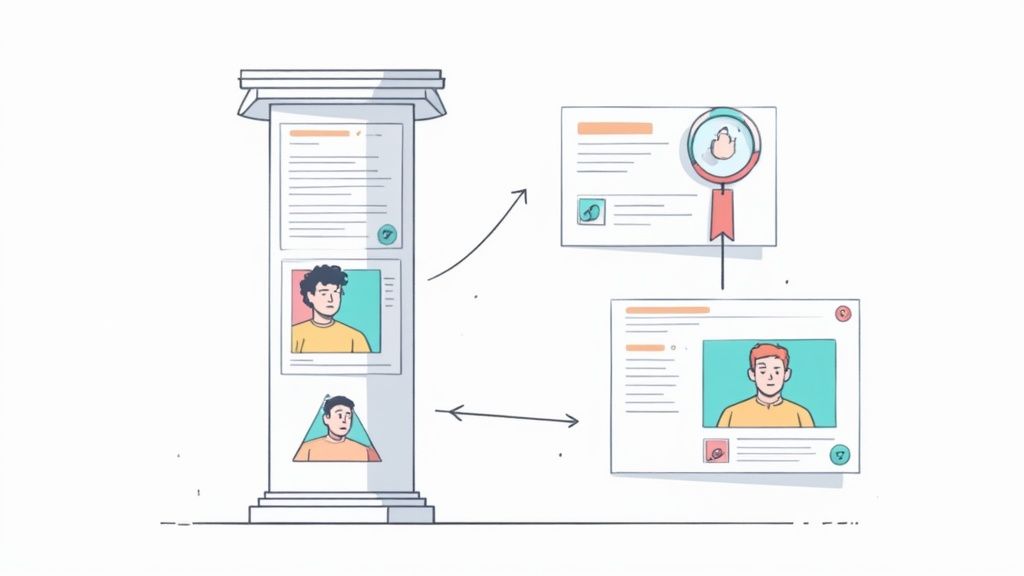
I learned this the hard way, scrambling to post everywhere, all the time. It was exhausting and ineffective. Things only started to click when I switched to a "Pillar Content" strategy. The idea is brilliant in its simplicity: create one fantastic, high-value piece of content, then slice it and dice it into smaller pieces for different platforms.

This method forces you to work smart, not just hard. It’s a way of respecting both your time and your audience's attention by delivering real value in a bunch of different formats.
The Pillar Content Method in Practice
So, what does this actually look like?
Imagine you write a detailed, insightful blog post on a topic you know inside and out. That's your pillar. From that single piece, you can spin out a whole ecosystem of content that cements your authority and grows your reach.
- A LinkedIn Article: This is your pillar content—a deep dive that thoroughly explores a topic and shows off what you know. This is the kind of thought leadership piece that’s perfect to feature when you build an online portfolio.
- An X (Twitter) Thread: Pull out the main arguments from your article and break them down into a 10-part thread full of quick, actionable tips.
- An Instagram Carousel: Grab a few key stats or a step-by-step process from the post and turn it into a super-shareable, visually engaging carousel.
- A Short-Form Video Script: Take the single most important takeaway and use it as a script for a 60-second TikTok or Reel.
Just like that, one big effort turns into a full week's worth of content. This guarantees you stay consistent and ensures your core message gets heard across different channels, meeting people wherever they are.
Brainstorming Ideas That Actually Resonate
The best content ideas live at the intersection of what your audience is desperate to know and what you genuinely love talking about. To find that sweet spot, I use a simple "listen, solve, and share" framework.
- Listen to Your Audience: Pay attention. What questions do people ask you over and over again? What are the common headaches you see popping up in industry forums or on LinkedIn? These are pure content gold.
- Solve a Specific Problem: Don't try to boil the ocean. Create content that solves one small, nagging problem. A post titled "5 Ways to Write Better Email Subject Lines" will always outperform a generic one like "How to Do Marketing." Specificity wins.
- Share Your Unique Perspective: How did you solve a problem? What was your personal experience? What did you learn that nobody else is talking about? This is what makes you different.
The most valuable content doesn’t just provide information; it provides perspective. Your unique viewpoint is what turns casual followers into a real community.
When you get this focused, you also unlock some powerful ways to make money. Monetizing a micro-niche is a huge trend, especially since 68% of consumers say brand stories influence what they buy. For a personal brand, that means creating content that truly connects with a specific group's pain points can lead to way higher engagement and loyalty. You can discover more insights on personal branding trends to see how this approach is shaping the future.
Choosing the Right Platforms to Build Your Presence
Trying to be everywhere at once is the fastest way to burn out. I learned this the hard way, juggling a half-dozen platforms and feeling like I was making zero progress on any of them.
The real breakthrough comes when you stop chasing every shiny new app and start making strategic choices. The goal isn't to be omnipresent; it's to be present where it matters. This means figuring out where your target audience actually spends their time and then going deep on just one or two platforms. Your energy is finite, so focus it for maximum impact.
When I decided to get serious, I went all-in on LinkedIn. I knew the professionals I wanted to connect with were there, and the platform favored the kind of in-depth, thoughtful content I actually enjoyed creating. This focused approach led to more meaningful growth than a year of scattered posting ever did.
Where Does Your Audience Live Online?
Your platform choice should start with audience research, not just personal preference. You have to align your brand with the culture and user base of each network. With the average person using 6.7 different social networks every month, your audience is definitely out there—you just need to find their primary hangout.
Here’s a quick breakdown to get you started:
- LinkedIn: The undisputed king for B2B professionals, consultants, and anyone in a corporate or tech-focused field. The content is professional, and the networking potential is immense.
- X (formerly Twitter): Perfect for real-time engagement, news, and jumping into fast-moving conversations. It's a great spot for writers, journalists, and tech thought leaders to share quick insights and build authority.
- Instagram: A visual-first platform ideal for designers, artists, coaches, and lifestyle brands. Carousels and Reels are powerful tools for storytelling and education.
- Niche Communities: Don't overlook platforms like Reddit, Discord servers, or industry-specific forums. These can be goldmines for building deep connections with a highly engaged, targeted audience.
Optimize Your Profile for Impact
Once you’ve picked your platforms, your profile becomes your digital storefront. It needs to instantly tell visitors who you are and why they should stick around. Think of it as your online home base—it’s essential to get it right.
A powerful profile has just a few key ingredients:
- A Professional Headshot: Use a clear, high-quality photo where you look approachable and confident. No blurry vacation pics.
- A Compelling Bio: Immediately communicate your value using your brand statement. A simple "I help X achieve Y by doing Z" works wonders.
- A Clear Call-to-Action: Tell people exactly what to do next. This could be visiting your portfolio, subscribing to your newsletter, or sending you a connection request.
Your social media profile isn't just a bio; it's your 24/7 sales pitch. Make it clear, compelling, and make sure it instantly communicates your value.
Ultimately, your profiles should funnel people to a central hub where they can really dig into your work. For most of us, that's a portfolio website. If you're looking for an easy way to create one, check out our guide on finding the right free portfolio website builder for your needs. It’s the final piece of the puzzle, connecting your social presence to your incredible body of work.
How to Grow and Monetize Your Personal Brand
You’ve laid the foundation, created amazing content, and built a real community. So, what's next? Let's talk about the payoff for all that hard work. Building a personal brand isn't just a passion project; it's a strategic career move, and turning your influence into income is the natural next step.
I used to think "monetization" was a dirty word. I worried that charging for my expertise would somehow cheapen the authentic connections I was building. But I quickly learned that the right offers don't detract from your brand—they deepen it. When you create services or products that genuinely solve your audience's biggest problems, you’re not selling out. You’re leveling up your ability to help them.

Making the leap from free content to paid offers is a journey, not a switch you flip overnight. It starts with recognizing that your expertise has real, tangible value. Remember, over 50 million people worldwide now consider themselves creators, and a huge chunk of them are building sustainable businesses around what they know. You can, too.
From Free Content to Paid Offers
The secret is to build a "value ladder." Don't jump straight from posting on social media to launching a high-ticket coaching program. That's jarring for your audience. Instead, you need to build a bridge that gently guides people from your free content to your paid solutions.
Here are a few proven paths you can take:
- Consulting or Freelancing: This is usually the most direct route. You've already proven what you know with your content; now you can offer it as a one-on-one service to solve very specific client problems.
- Speaking Gigs: As your authority grows, companies and event organizers will pay for your insights. You don't have to start with a TED Talk. Begin by speaking at smaller local events or appearing on podcasts to build up your experience.
- Digital Products: Think ebooks, Notion templates, or short video courses. These are fantastic because you create them once and can sell them over and over, generating income that isn't directly tied to your time.
- Affiliate Marketing: If there's a tool or product you genuinely use and love, you can earn a commission by recommending it. Just make sure it's a perfect fit for your audience—your trust and credibility are on the line.
Monetization isn't about finding customers for your products. It's about finding products for your people. Listen to their struggles, and the right offers will become obvious.
Pricing Your Services and Attracting Clients
Putting a price tag on your expertise is one of the toughest parts of this process. My best advice? Price based on the value and transformation you deliver, not just the hours you put in. Sure, check out what others in your niche are charging, but don't let that be your only guide. Your unique perspective and proven results are worth a premium.
To actually land clients, you need a simple, clear system. Your content should act as a magnet, drawing interested followers to a central hub—like your portfolio. This is where you make your case. For instance, showcasing your projects on a polished graphic designer portfolio site gives potential clients the social proof they need to hire you. Make it dead simple for them to see your work, understand your process, and get in touch.
Finally, you have to track what actually matters. It's easy to get lost in vanity metrics like follower counts. Instead, focus on the numbers that signal real business growth:
- Profile Views: How many new people are discovering you each week?
- Engagement Rate: Are people actually interacting with your content in meaningful ways (comments, shares, saves)?
- Inbound Leads: How many people are reaching out to you asking for help?
By keeping an eye on these key metrics, you can see what’s resonating, fine-tune your strategy, and turn your personal brand into a sustainable, profitable engine for your career.
Common Questions About Building a Personal Brand
When you’re first diving in, it's completely normal for your head to be spinning with questions. Let's walk through some of the most common hurdles and mental roadblocks I see people hit when they start building their personal brand.
How Long Does This Actually Take?
This is the big one, isn't it? The honest answer is there’s no magic number. I’ve seen some people get real traction in just three months, while for others, it’s closer to a full year.
From my experience, you should plan to invest at least 6-12 months of consistent effort before you start seeing significant momentum. The key word there is consistency, not intensity.
Showing up 2-3 times a week with genuinely helpful content and actually talking to your community builds momentum way faster than a flurry of posts followed by silence. Think of it like planting a tree—the initial growth feels painfully slow, but over time, it develops deep, strong roots.
What if I Don’t Feel Like an Expert?
Welcome to the club! Seriously, almost everyone feels this way. It even has a name: "imposter syndrome." But here's the good news—you don't need to be the world's foremost authority on a topic to build a valuable personal brand.
Instead, shift your mindset. See yourself as a guide who is just a few steps ahead of your audience. Document what you're learning right now, share the challenges you're overcoming, and pull together information for others. Your unique perspective is a powerful form of expertise.
A brand can be built on curiosity just as effectively as it can be built on decades of experience. Share your journey, not just your destination.
Can an Introvert Build a Personal Brand?
Absolutely. In fact, I'd argue that some of the most powerful personal brands are built by introverts. Building a brand isn’t about being the loudest person in the room; it's about making a meaningful, authentic connection.
Many introverts naturally excel at creating thoughtful, well-researched written content or forming deep, one-on-one relationships. Platforms like LinkedIn, Substack, or even a personal blog are perfect for this. You get to control the pace of the conversation and focus on quality engagement rather than high-energy performances. Just lean into your natural strengths.
How Do I Handle Negative Feedback?
As your visibility grows, you'll eventually run into some negativity. It's just part of the process. The first thing to do is assess where it's coming from. Is it constructive feedback from someone in your field? If so, try to learn from it without taking it personally.
But if it’s an unfounded attack from a troll? The best policy is almost always to ignore, block, and move on. Engaging only amplifies their voice and drains your energy. Remember, your brand is for your target audience, not for everyone. A few detractors are often a sign that you're standing for something meaningful.
Ready to build a stunning online home for your brand in minutes? With Fantastic Portfolios, you can turn your resume into a professional, AI-powered portfolio website in under 30 seconds. Showcase your work, prove your expertise, and attract the opportunities you deserve. Create your free portfolio today.