
How to Build a Powerful Business Portfolio
Think of a business portfolio as the complete collection of everything your company owns and sells. It’s not just a list; it’s a strategic map of all your assets—from products and services to different brands and even investments. This map is what helps you make smarter decisions about where to put your time, money, and energy to get the best results.
What Is a Business Portfolio and Why Is It Crucial?

Let’s cut through the jargon. A ‘business portfolio’ isn’t just a fancy term for massive corporations. It’s a powerful tool for any company that wants to grow, no matter its size. When you start seeing your company through a portfolio lens, you begin to evaluate each piece—every product line, service, or brand—as its own separate investment.
I once worked with a small digital agency that was struggling to stay profitable because their services were all over the place. They did everything from SEO to social media and web design, but with no clear focus, their team was stretched thin and their impact was diluted.
Once we organized their offerings into a proper business portfolio, it was suddenly crystal clear which services were the winners and which were just draining resources. They decided to cut the low-impact services and double down on what they did best. The result? A 30% revenue jump in just one year.
The Strategic Advantage of a Portfolio View
This story gets to the heart of it: a well-managed portfolio isn’t about having more stuff. It’s about having the right stuff working together seamlessly. This perspective completely changes how you make decisions.
A well-executed brand portfolio strategy guides investment decisions, identifies brands that need improvement or removal, and spots opportunities for new brands to fill gaps in the market.
This kind of strategic clarity lets you allocate your resources with surgical precision. Instead of spreading your budget and talent thinly across the board, you can funnel them into the areas with the highest potential return. And this isn’t just for the big players managing dozens of brands; it’s an incredibly powerful discipline for startups and small businesses, too. A solid portfolio approach can even become a core part of your company’s identity, much like the ideas explored in our articles on personal branding.
Unlocking Growth and Optimizing Resources
At the end of the day, the goal is to create a whole that is far more valuable than the sum of its parts. A strategic business portfolio gives you a clear framework to make that happen.
Here’s a quick look at how it helps you move forward:
- Improved Decision-Making: With a clear view of how everything is performing, you can make data-driven choices about where to invest, what to cut, and when it’s time to innovate.
- Enhanced Resource Allocation: It ensures your most precious assets—your time, money, and people—are locked in on the activities that actually move the needle.
- Sustainable Growth: By balancing your reliable, money-making products with new, high-potential ventures, you build a resilient business model that’s ready for the long haul.
To give you a clearer picture, here’s a breakdown of the key advantages a business portfolio brings to the table.
Key Advantages of a Strategic Business Portfolio
| Benefit Area | Description | Impact on Business |
|---|---|---|
| Strategic Clarity | Provides a big-picture view of all business units, products, and investments. | Facilitates more informed, cohesive, and forward-thinking strategic planning. |
| Risk Management | Diversifies revenue streams, reducing dependency on a single product or market. | Creates a more resilient business that can better withstand market shifts and downturns. |
| Resource Optimization | Helps identify high-performers (“stars”) and underperformers (“dogs”). | Ensures capital, talent, and time are channeled into areas with the highest ROI. |
| Growth Identification | Uncovers new market opportunities and highlights areas ripe for innovation. | Drives sustainable growth by balancing mature products with emerging ventures. |
| Performance Measurement | Establishes clear metrics to evaluate the success of each portfolio component. | Enables data-driven decisions on investment, divestment, or operational changes. |
Ultimately, adopting a portfolio mindset is about being intentional and strategic, ensuring every part of your business is working together to build a stronger, more profitable future.
Understanding the Different Types of Portfolios
Not all business portfolios are built from the same blueprint; the right structure really depends on your company’s size and what you’re trying to achieve. It reminds me of a chat I had with a founder who was completely overwhelmed by complexity. Her company wasn’t a huge conglomerate, but it wasn’t a simple one-product shop, either. We broke it down into the core types, which immediately brought some much-needed clarity to her strategy.
Picking the right model is a critical decision that shapes how you spend your money, time, and energy. There’s no magic number for the ideal portfolio size, and there’s definitely no one-size-fits-all structure. The whole point is to find a model that gives you the clearest view of your business so you can make smarter moves.
This infographic breaks down the three main models that companies typically use.
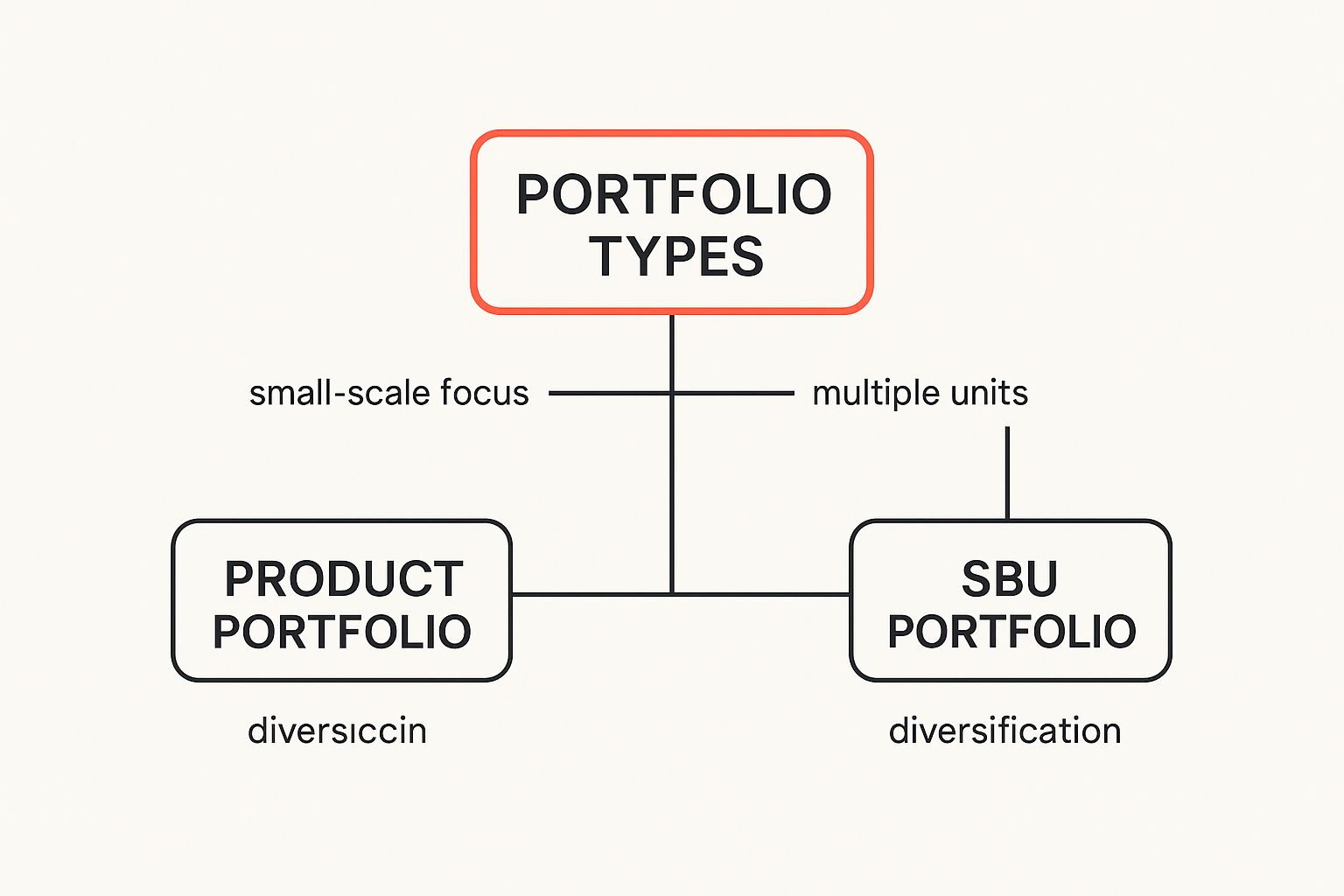
As you can see, there’s a clear hierarchy here, moving from the focused Product Portfolio all the way up to the diversified Investment Portfolio. It’s a great visual for how strategic management can scale with a business.
The Product Portfolio
For many businesses, especially those just starting out or dominating a specific niche, the Product Portfolio is the most intuitive way to go. It’s simply a collection of the products or services you sell. For a software company, this might be a freemium plan, a pro version, and an enterprise solution. Each one is an asset that needs to be managed.
This approach is fantastic for staying focused. A friend of mine runs a boutique design agency and uses this model perfectly. Her portfolio is made up of branding packages, web design services, and social media retainers. Looking at it this way, she can easily see that while branding brings in 60% of her revenue, the retainers are what give her that predictable, steady cash flow.
To see this concept in action, you can check out some great examples of a product designer’s portfolio structure.
The Strategic Business Unit Portfolio
As a company gets bigger and starts to branch out, it often outgrows a simple product list. That’s where the Strategic Business Unit (SBU) Portfolio comes into play. An SBU is basically a self-contained part of the business—like a specific brand or division—that has its own mission but still ladders up to the larger corporate goal.
Think of a large hospitality group. It might have a fine-dining restaurant, a chain of casual bistros, and a corporate catering service. Each of those is a separate SBU. They have their own customers, marketing budgets, and success metrics, but they all operate under one corporate umbrella.
The goal is to make the whole more valuable than the sum of its parts. Each SBU must have a distinct role and should not internally compete for the same customers.
This structure allows for specialized management and clear accountability, which is absolutely crucial when you’re juggling a lot of moving parts.
The Investment Portfolio
Finally, we have the Investment Portfolio model. This is for companies that hold financial stakes in other ventures, which are often external. The primary goal here isn’t operational synergy; it’s all about diversification and financial return.
A big tech corporation might create a venture capital arm to invest in promising startups. Or a manufacturing firm might buy shares in a supplier of its raw materials.
This approach helps a business spread its risk far beyond its core operations and tap into new growth areas without having to build everything from the ground up. It’s a smart, strategic play for long-term financial health and resilience.
How to Analyze Your Portfolio with Proven Frameworks
So you’ve got your business portfolio all mapped out. Great. Now for the real question: is it actually working for you? This is the point where strategic analysis needs to push guesswork out the door. Flying blind is a surefire way to burn resources on assets that simply aren’t pulling their weight.
Instead, we can lean on a couple of proven frameworks to get an objective, data-driven look at what to grow, what to maintain, and what it’s time to cut loose. I’ve sat in countless strategy meetings where passion for a pet project completely clouded everyone’s judgment, leading to some truly awful investment decisions. These frameworks are the perfect antidote to that kind of emotional thinking. They force you to look at the cold, hard numbers and the realities of the market.
Let’s get hands-on with two of the most effective tools for the job.
The Boston Consulting Group (BCG) Matrix
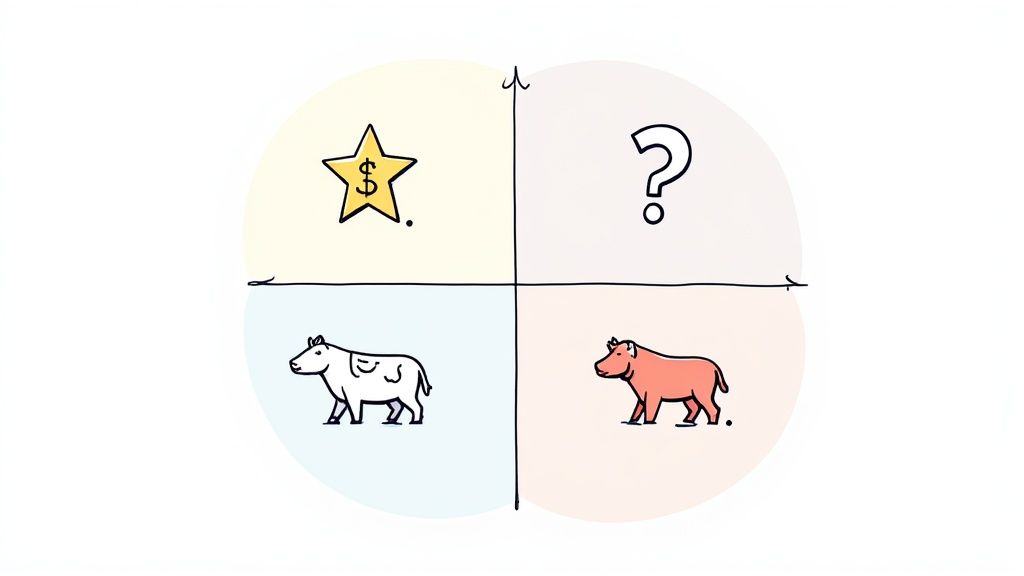
The BCG Matrix is a classic for a reason: it’s simple, powerful, and often incredibly revealing. It helps you sort every single product, service, or business unit into one of four quadrants. The two factors are its market growth rate (how fast the industry is expanding) and its relative market share (how strong your position is).
Think of it as a strategic snapshot of your entire business. Each quadrant tells a completely different story about an asset’s role and its future potential:
- Stars (High Growth, High Share): These are your rising champions. They operate in booming markets and already have a strong position. Stars demand serious investment to fuel their growth and fend off competitors, but they have the potential to become your next big moneymakers.
- Cash Cows (Low Growth, High Share): Meet your reliable workhorses. They are the established leaders in mature, slow-growing markets and generate way more cash than they consume. The strategy here is to “milk” these assets, using the steady profits to fund your Stars and take a chance on a few promising Question Marks.
- Question Marks (High Growth, Low Share): These are the wild cards. They’re in high-growth markets but just haven’t managed to capture a significant share yet. They are incredibly cash-hungry, and their future is totally uncertain—they could become Stars with the right investment, or they could fizzle out and fade away.
- Dogs (Low Growth, Low Share): These are the underperformers. Dogs have a weak position in a low-growth market. They often break even at best and can become a real drain on resources and management’s time. The typical advice? Divest or phase them out.
For example, think about a giant like Coca-Cola. Classic Coke is the definitive Cash Cow, dominating a mature market and funding other ventures. An experimental new energy drink would start its life as a Question Mark, needing a ton of investment to see if it can gain traction and eventually become a Star.
The GE/McKinsey Nine-Box Matrix
While the BCG Matrix is fantastic for a quick, high-level overview, sometimes you need more nuance. The GE/McKinsey Nine-Box Matrix gives you a more detailed analysis by evaluating your business units on two broader axes: Industry Attractiveness and Business Unit Strength.
This framework moves beyond simple market share to consider a much wider range of factors, offering a more complete picture for making complex investment decisions.
“Industry Attractiveness” isn’t just about growth rate; it includes things like market size, overall profitability, the level of competition, and technological factors. In the same way, “Business Unit Strength” looks past market share to include brand equity, operational efficiency, customer loyalty, and the talent on your team.
Each axis is divided into high, medium, and low, creating a nine-box grid. This grid provides clear, actionable strategic guidance:
- Invest/Grow: Any units landing in the top-left boxes (high strength, high attractiveness) are prime for investment. Go all in.
- Selectivity/Earn: Those in the middle diagonal require a more cautious approach. You’ll want to invest selectively only in the most promising areas.
- Harvest/Divest: Units stuck in the bottom-right (low strength, low attractiveness) are clear candidates for divestment or shutdown.
Effective analysis is a cornerstone of Strategic Planning for Small Business Growth, which directly impacts the performance and direction of your entire portfolio. By applying these frameworks, you’re not just organizing your assets; you’re building a clear, actionable roadmap for a stronger, more profitable future.
Global Trends Shaping Modern Portfolios
Your business portfolio doesn’t live in a bubble. It’s constantly being nudged and reshaped by huge global currents, and the smartest companies are learning how to ride those waves.
For years, I’ve seen businesses get so laser-focused on their core products that they’re completely blindsided by a sudden market shift. The companies that thrive today are the ones looking outward, adapting their mix of offerings to what’s happening on a much larger scale.
One of the biggest shifts we’re seeing is a major move toward broad diversification. This isn’t just about launching a slightly different product. It’s a fundamental change in how businesses build lasting value and shield themselves from volatility. Capital is flowing into all sorts of different assets, well beyond the traditional stuff.
The numbers here are staggering. Global assets under management (AuM) are projected to swell from US$84.9 trillion in 2016 to a massive US$145.4 trillion by 2025. A huge slice of that growth is coming from passive investments, which are expected to more than double to US$36.6 trillion, and alternative assets climbing to US$21.1 trillion. These figures point to a clear global playbook: spread the risk and chase growth wherever you can find it.
Diversification Beyond Products
So, what does this mean if you’re not a massive investment firm? It means you need to think of your business portfolio as more than just the things you sell. For a small business, this could be about diversifying your income to build a more stable financial base.
Think about a marketing agency that primarily earns money from client projects (an active revenue stream). They might decide to create and sell an online course or a set of digital templates. Suddenly, they have a passive income stream that helps smooth out the natural boom-and-bust cycle of client work, making the whole operation more resilient when things get quiet.
The New Focus on Stability and Growth
In an uncertain economy, investors of all stripes—from giant institutions to solo entrepreneurs—are putting a much higher value on stability. The goal is no longer just explosive growth at any cost; it’s about achieving sustainable growth that can actually weather a storm.
A modern business portfolio must balance its high-growth, high-risk “Star” ventures with stable, income-generating “Cash Cow” assets. This balance is the key to building a future-proof enterprise that can innovate without jeopardizing its core stability.
This mindset is critical for any business owner. Are you using the profits from your steady, reliable products to fund promising new ideas? Are you exploring digital assets or services that could complement your physical ones? The ongoing digital shift, driven by things like the latest trends in AI content generation, is unlocking entirely new ways to create value.
Ultimately, connecting your internal portfolio strategy to these larger global trends is about being proactive, not reactive. It’s how you shift from just running the business day-to-day to strategically positioning it for long-term success in a world that never stops changing.
Inspiring Examples of Powerful Portfolios in Action

It’s one thing to talk about portfolio frameworks in theory, but it’s another to see them working in the real world. That’s where the concepts really start to click. A great business portfolio isn’t just about collecting assets for the sake of it; it’s about strategically putting pieces together so they achieve something bigger.
I’ve seen firsthand how a well-managed portfolio can completely change a company’s path, whether it’s a tech giant funding moonshots or a family business protecting its legacy. Let’s look at a few examples from different industries to see what this looks like in action.
The Tech Titan Playbook: Alphabet
Alphabet, Google’s parent company, is a masterclass in portfolio strategy. Think of it this way: Google Search and its advertising empire are the ultimate Cash Cows. This part of the business generates enormous, reliable profits that act as the engine for everything else.
That steady cash flow gives Alphabet the freedom to pour money into its “Other Bets” division. These are the high-risk, high-reward Question Marks and potential Stars—think Waymo (self-driving cars) and Verily (life sciences). Not all of these big bets will pay off, but the portfolio structure lets Alphabet chase world-changing ideas without putting its core business on the line.
The Private Equity Pivot: Creating Operational Value
The private markets offer another powerful lesson. For years, the private equity game was all about financial engineering—using leverage to buy companies and then selling them for a quick profit. But that game has changed. Today, the focus has shifted to rolling up their sleeves and making hands-on operational improvements to create real, lasting value.
A great portfolio is ultimately about achieving a strategic purpose, not just hitting quarterly numbers. It’s the engine that balances today’s stability with tomorrow’s growth.
A recent McKinsey report highlights this pivot, noting that managers are driving value through genuine operational transformation. Confidence in this approach is strong, with most leading limited partners planning to increase their capital in private markets. This is all about unlocking the hidden potential within each company in the portfolio—a lesson any business owner can learn from. You can dive deeper by checking out the full report on global private markets.
The Family Business: Legacy and Longevity
Finally, let’s look at the unique world of family-owned businesses. I’ve always admired their approach because their portfolios are often built on something more than just financial returns. They’re balancing profit with purpose, legacy, and long-term family values.
A family business might hold a diverse portfolio that includes its main company, some real estate, and maybe a philanthropic foundation. This structure creates incredible resilience. The different assets act as a safety net, allowing the core business to survive economic storms while making sure the family’s legacy continues for generations. It’s a powerful reminder that a portfolio is a tool for building lasting value. Of course, presentation matters too, and you can get inspired by these examples of a portfolio cover page.
Your Step-by-Step Guide to Building a Business Portfolio
Alright, we’ve covered the theory and seen some great examples in the wild. Now, it’s time to roll up our sleeves and put that knowledge into practice. Building or refining a business portfolio is a disciplined process, but it’s far from complicated. I’ve walked countless founders through this, and it always boils down to five clear, manageable stages.
Think of this as your blueprint. Follow it, and you’ll create a lean, strategic portfolio that’s perfectly tuned to your most important business goals. Let’s get into it.
Step 1: Define Your Strategic Vision
Before you even glance at a single product or service, you have to look inward. What’s the ultimate goal? This isn’t about fluffy mission statements; it’s about defining a crystal-clear destination for your company. Are you shooting for rapid market share growth? Maximum profitability? Or maybe rock-solid, long-term stability?
Your vision is the filter for every decision that comes next. A company obsessed with innovation is going to build a very different portfolio than one focused on being the low-cost leader. Without this clarity, you’re just collecting assets that pull your business in a dozen different directions.
Step 2: Audit Your Current Assets
Next up: a brutally honest inventory. What do you actually have in your portfolio right now? List out every single product, service, brand, SBU, or investment. Leave no stone unturned.
For each one, gather the hard data:
- Financials: Revenue, profit margins, and what it costs to keep the lights on.
- Market Position: Where do you stand in the market? What are customers saying?
- Resource Drain: How much management time and employee effort does it really consume?
This audit almost always unearths some surprising truths. I once worked with a company that discovered 20% of its products were eating up nearly 60% of its support resources for pocket-change profits. That one insight changed everything for them.
Step 3: Analyze and Categorize
With your data in hand, it’s time to pull out those frameworks we talked about, like the BCG Matrix. Plot every single asset into one of the four quadrants—Stars, Cash Cows, Question Marks, or Dogs. This is where you have to be ruthlessly objective.
This exercise forces you to see your assets for what they are: investments with specific jobs. That service you’re emotionally attached to might actually be a “Dog” that’s bleeding you dry, while a quiet “Cash Cow” you never think about could be the unsung hero funding your entire growth strategy.
The whole point of analysis is to swap emotional attachment for strategic clarity. The data will tell you the real story of each asset’s contribution. You just have to be willing to listen.
Step 4: Make Strategic Decisions
Here’s where analysis turns into action. Based on where each asset landed on your matrix, you’ll choose one of four moves:
- Invest: Pour fuel on the fire. Funnel more resources into your Stars and the most promising Question Marks to accelerate their growth and lock down their market leadership.
- Maintain: Protect your Cash Cows at all costs. Don’t over-invest in a mature market; just harvest their profits efficiently. Their job is to bankroll the rest of the portfolio.
- Divest: It’s time to cut the dead weight. Sell off or shut down your Dogs and any Question Marks that just aren’t getting traction. This is often the toughest step, but it’s absolutely critical for freeing up capital and focus.
- Harvest: For some underperformers, you might choose to slash costs to the bone and squeeze out every last drop of short-term cash before phasing them out for good.
Step 5: Implement and Monitor
Finally, you execute the plan. But just as importantly, you track your progress relentlessly. A business portfolio is a living thing, not a “set it and forget it” project. You need to establish key performance indicators (KPIs) to monitor how each asset is performing against your strategic goals.
This is another area where modern AI-powered tools are becoming incredibly helpful. They can model future scenarios with startling accuracy, giving you a glimpse into the potential impact of your decisions before you commit. This ongoing cycle of action and monitoring ensures your portfolio stays dynamic, responsive, and always pointed toward your vision.
For creative professionals, this structured thinking is just as essential. Many of these principles apply directly to building a professional showcase, and you can see how in these fantastic tips for a graphic designer portfolio site.
Common Questions About Business Portfolios
After walking dozens of companies through their portfolio strategy, I’ve started to see the same questions pop up. It’s only natural. So, let’s clear the air and tackle some of the most common questions I get about building and managing a business portfolio.
How Often Should I Review My Business Portfolio?
Think of your portfolio as a living, breathing part of your business, not some static document you file away and forget. For my clients, I recommend a quick, high-level review every quarter. This is your chance to check in on performance and make sure you’re hitting your goals.
But the real deep-dive, the kind where you break out frameworks like the BCG Matrix, should be an annual tradition. That said, don’t wait for the calendar to tell you when to act. If a major market shift happens—a new competitor storms the scene or a game-changing technology emerges—that’s your cue to pull your portfolio out for an immediate, thorough review. Your strategy has to match the reality on the ground.
Can a Small Business Have a Portfolio?
Absolutely. In fact, I’d argue it’s even more crucial for them. A “portfolio” for a startup might just be its main product, a service in beta, and a few key pieces of intellectual property. It’s not about having dozens of brands; it’s about adopting a strategic mindset from day one.
When you’re small, every dollar and every hour counts. A portfolio approach forces you to be disciplined about where you put those precious resources. I recently came across a study noting that the most successful startups focus 95% of their resources on a single core offering. Thinking in terms of a portfolio helps you spot that potential “Star” instead of accidentally starving it by spreading your efforts too thin.
What Is the Biggest Mistake in Portfolio Management?
Hands down, the single most damaging mistake I see is emotional attachment. It happens all the time. Leaders and founders get sentimental about a product or service—often the “Dogs” in the BCG Matrix—because it was their first big idea or it holds personal meaning.
But great portfolio management requires ruthless objectivity. Letting go of an underperforming business isn’t a sign of failure. It’s a strategic move. It frees up capital, talent, and time that you can pour directly into your winners. For more on sidestepping these kinds of traps, you can find a ton of great portfolio tips in our other articles.
Ready to build a professional website that showcases your unique skills and experience? With Fantastic Portfolios, you can turn your resume into a stunning, AI-powered portfolio in under a minute.